November 6, 2026
Tree Fungus and Root Rot in Montgomery County, MD
What mushrooms and shelf fungus at a tree’s base can mean for root and trunk decay, with real examples from Bethesda, Potomac, Rockville and Olney.
By John Ritz Miller, Jr. — ISA Certified Arborist MA-7241A, Rock Creek Tree, Turf & Landscape LLC
Published November 6, 2026
A mushroom or shelf fungus growing at the base of a tree can be a sign of something happening inside the wood. Some fungi break down the roots or lower trunk that hold a tree up. Others growing nearby may be feeding on old buried wood rather than the living tree. This guide explains what tree fungus and root rot can mean for mature trees in Montgomery County, MD, with real examples from Bethesda, Potomac, Rockville and Olney.
If you find substantial fungal growth on a tree, its root flare or major surface roots, have it evaluated, especially when the tree could reach your home, driveway, deck or play area. Fungus does not automatically mean a tree needs to be removed, but it is a reason to take a closer look.
The five fungus photos below come from Rock Creek customer properties in Montgomery County. The descriptions are based on appearance and are provisional. A photo cannot establish the extent of internal decay or a tree’s likelihood of failure.
Why tree fungus at the base of a tree matters
The visible mushroom or shelf is the fungus’s fruiting body. Much of the organism can be inside the wood or below ground. Removing the part you can see does not remove the fungus from the tree or repair wood that has already decayed.
Root rot affects the roots that anchor the tree. Butt rot is decay in the lower trunk, often near the root flare, the widening area where the trunk meets the ground. Significant decay in either area can weaken a tree’s structure.
A tree can still have green foliage while decay develops in its roots or trunk. That is why we look at the whole tree, not just the leaves. At the same time, mushrooms in the lawn do not always mean the living tree is infected. Some grow on old stumps, buried roots or mulch.
Common tree fungi on mature trees in Montgomery County
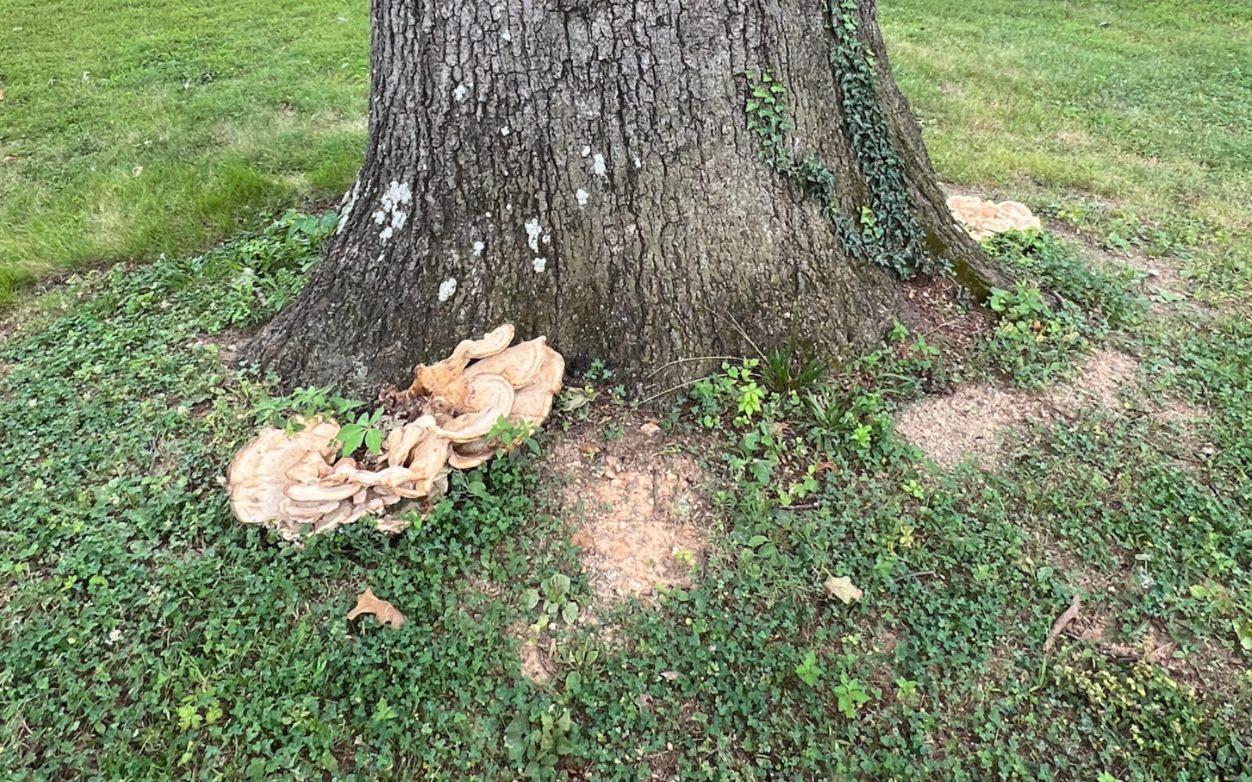
Berkeley’s polypore often forms large, overlapping cream or tan caps at the base of oaks or near major roots. It is associated with root and lower-trunk decay. Black-staining polypore can look similar but typically darkens or stains black when bruised. Both can be difficult to tell apart from photos alone.
Ganoderma fungi can form reddish-brown or gray-brown shelf-like conks, sometimes with a lighter edge or underside. Appearance varies by species and age, and some Ganoderma species cause root and lower-trunk decay. An arborist can examine the fungus and the tree before drawing conclusions.
Real examples from Bethesda, Potomac, Rockville and Olney
1. Old Chester Road, Bethesda
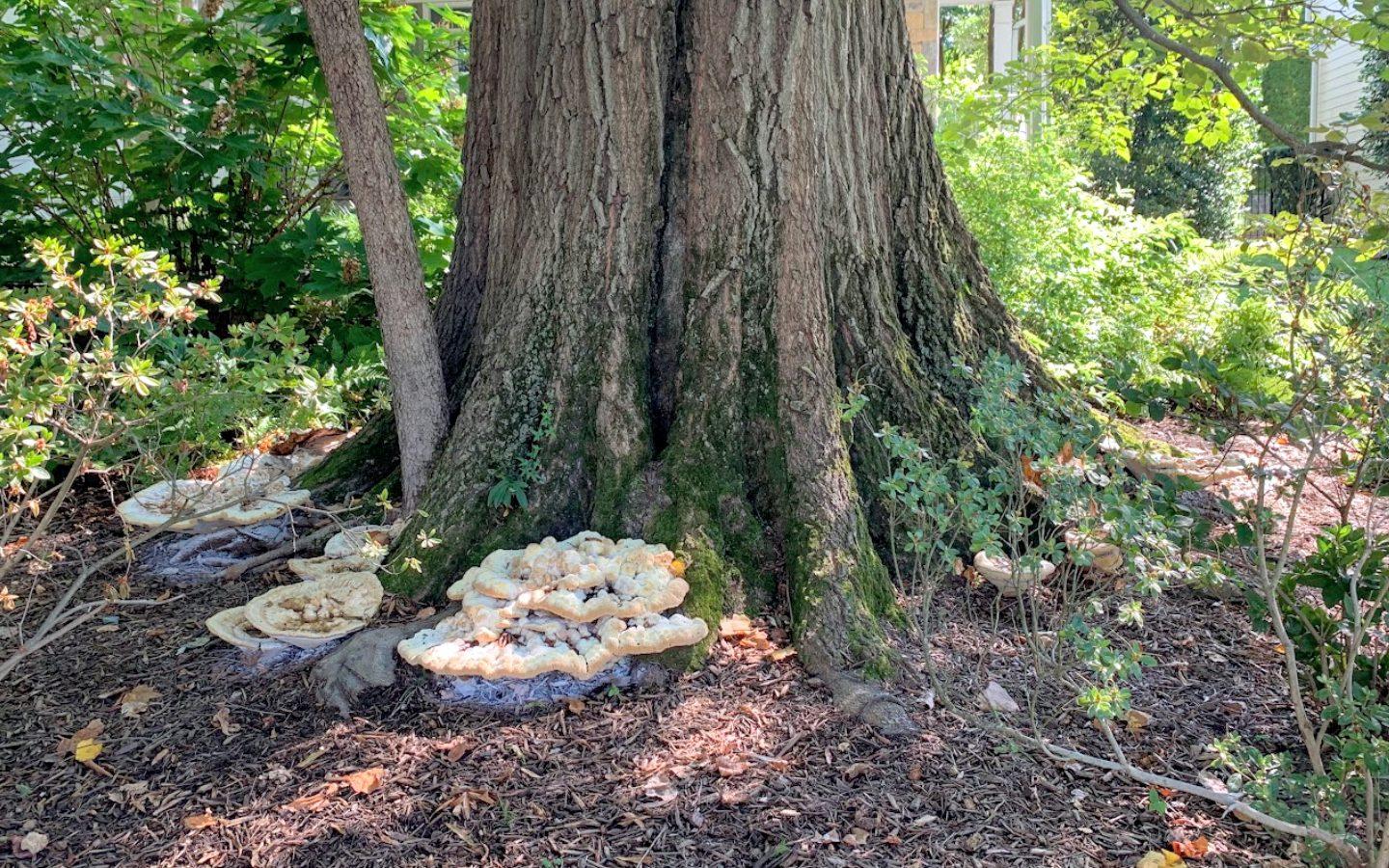
This large red oak on the 7700 block of Old Chester Road in Bethesda has broad, pale fungal clusters around its root flare. The growth resembles Berkeley’s polypore, though a closer examination would be needed to distinguish it from similar species. The concern is possible decay in the roots or lower trunk, not simply the size of the visible mushrooms.
2. Near Tuckerman Lane, Potomac
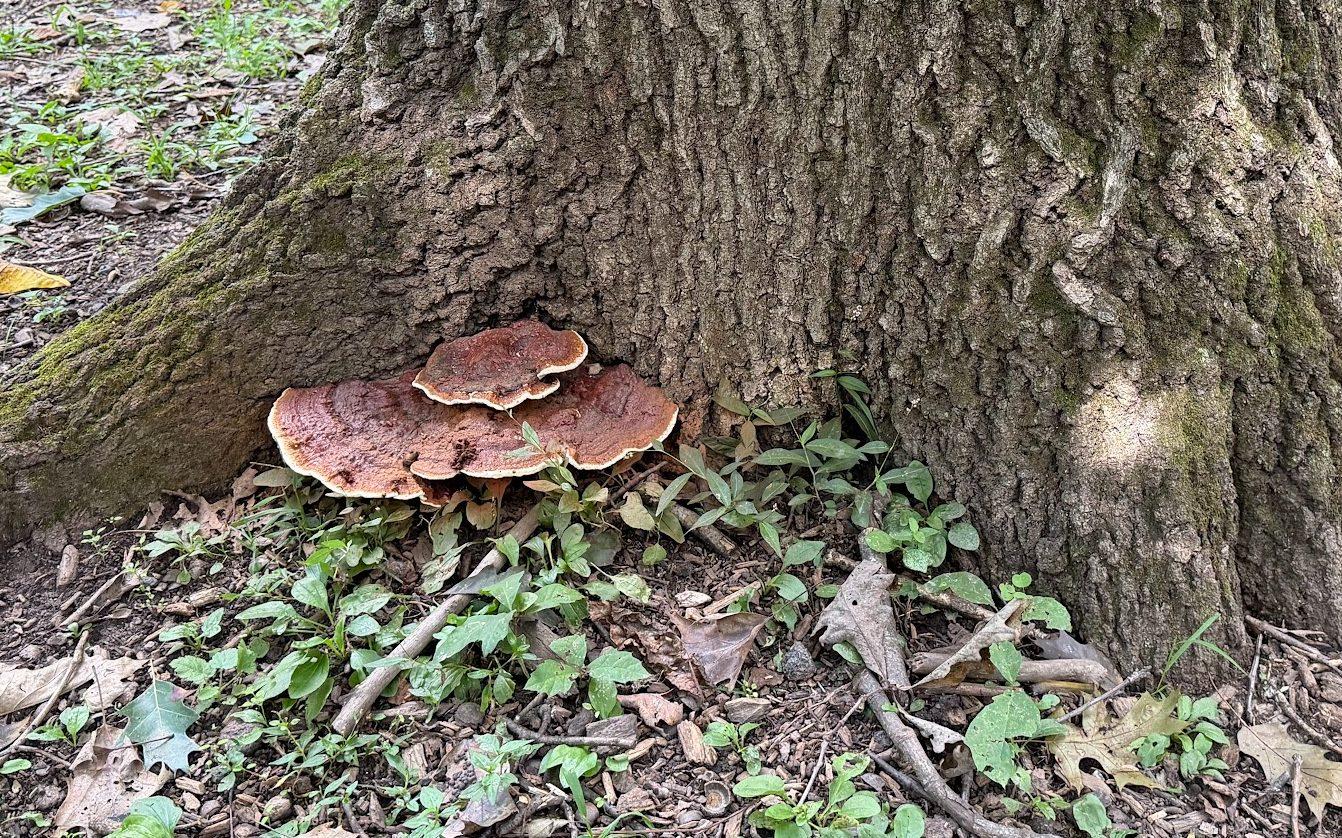
At a property off Tuckerman Lane in Potomac, a dark reddish-brown shelf with a pale edge is growing near the base of a tree. It could be a Ganoderma-type fungus, but the species cannot be confirmed from this photograph. When a shelf fungus appears at the trunk or root flare, we want to inspect the lower trunk and supporting roots for signs of decay.
3. South Van Buren Street, Rockville
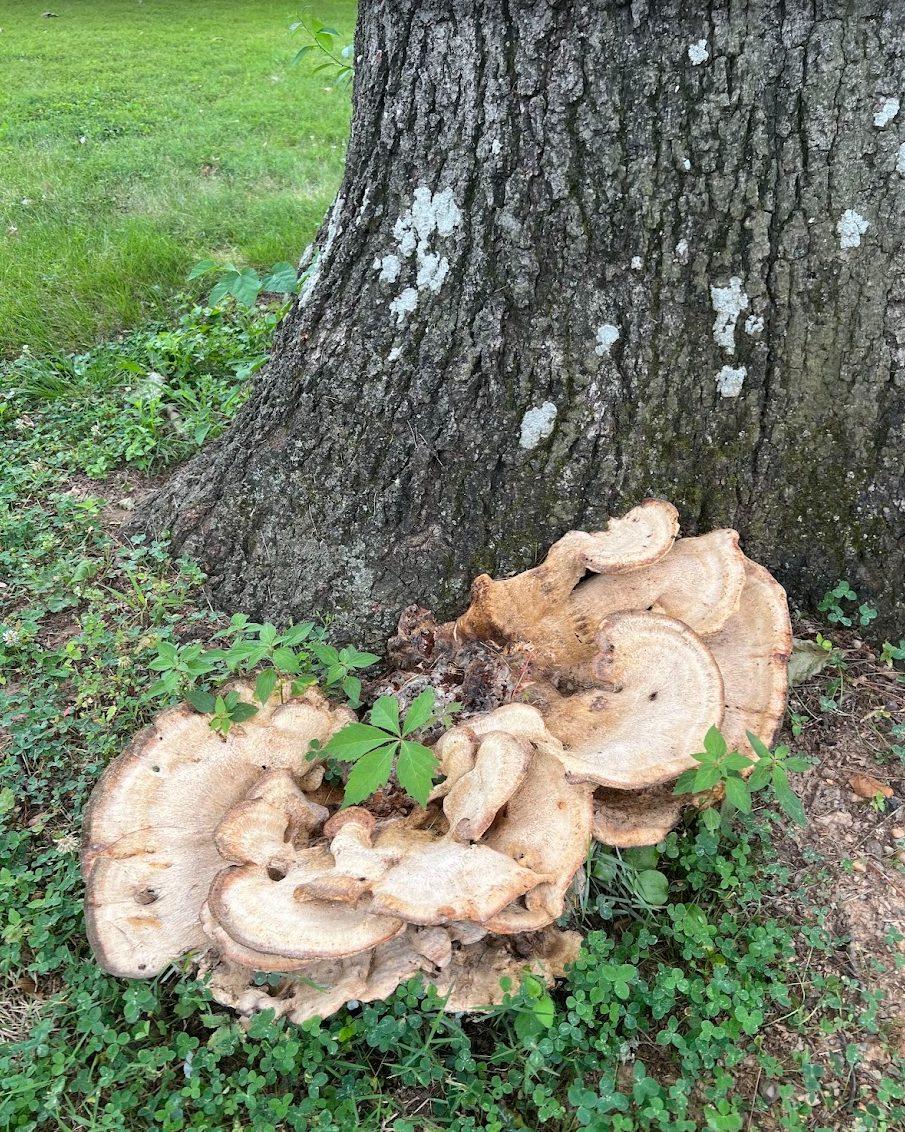
On South Van Buren Street in Rockville, this mature red oak has broad cream and tan fungal caps near its base. The growth resembles Berkeley’s polypore; black-staining polypore and other lookalikes are also possibilities. The underside, texture and bruising response can help with identification. The key question is whether decay affects the supporting roots or the lower trunk.
4. Hillmead Road, Bethesda
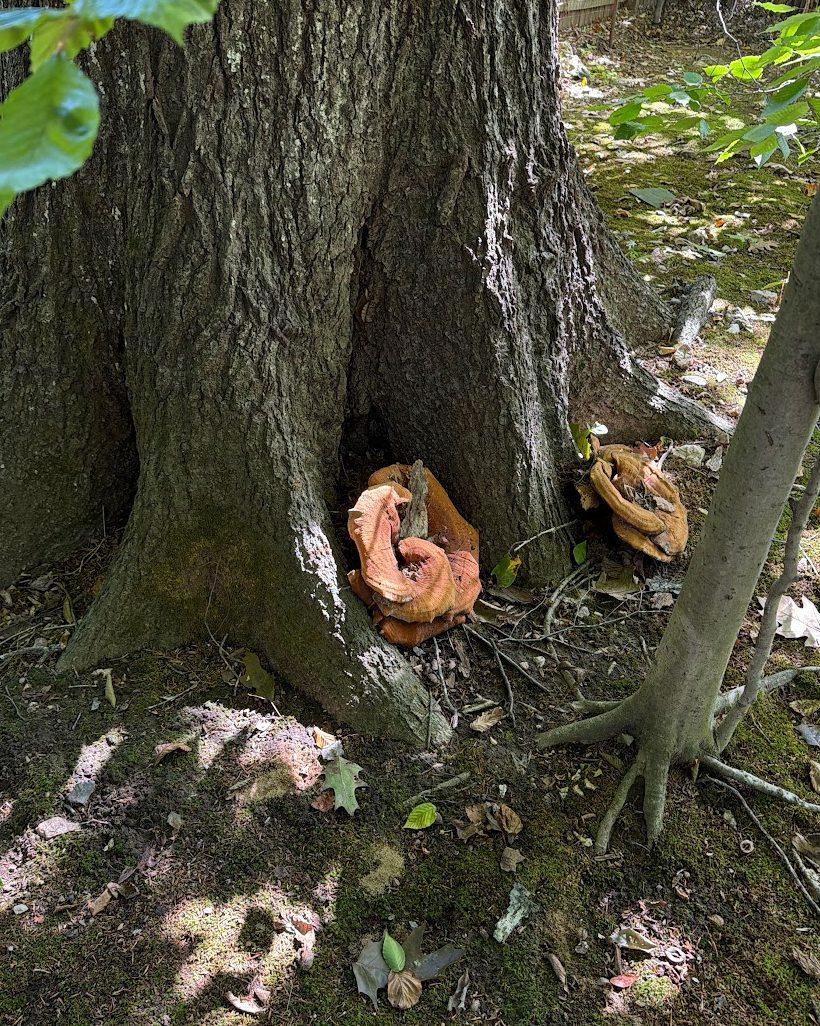
This large backyard oak on the 6600 block of Hillmead Road in Bethesda has orange-brown shelf-like growth at its base. The photograph supports describing it as a bracket or polypore-type fungus, but not identifying a particular species. The fungal growth and the dark recess around the root flare are reasons to inspect the base and roots more closely.
5. Near Queen Elizabeth Drive, Olney
At a property off Queen Elizabeth Drive in Olney, pale, overlapping fungal clusters are visible near the root flare of a mature oak. They resemble Berkeley’s polypore, although identification remains unconfirmed. Growth like this is a reason to assess the root system and lower trunk rather than judge the tree’s condition from its canopy alone.
When a large tree uproots near a home
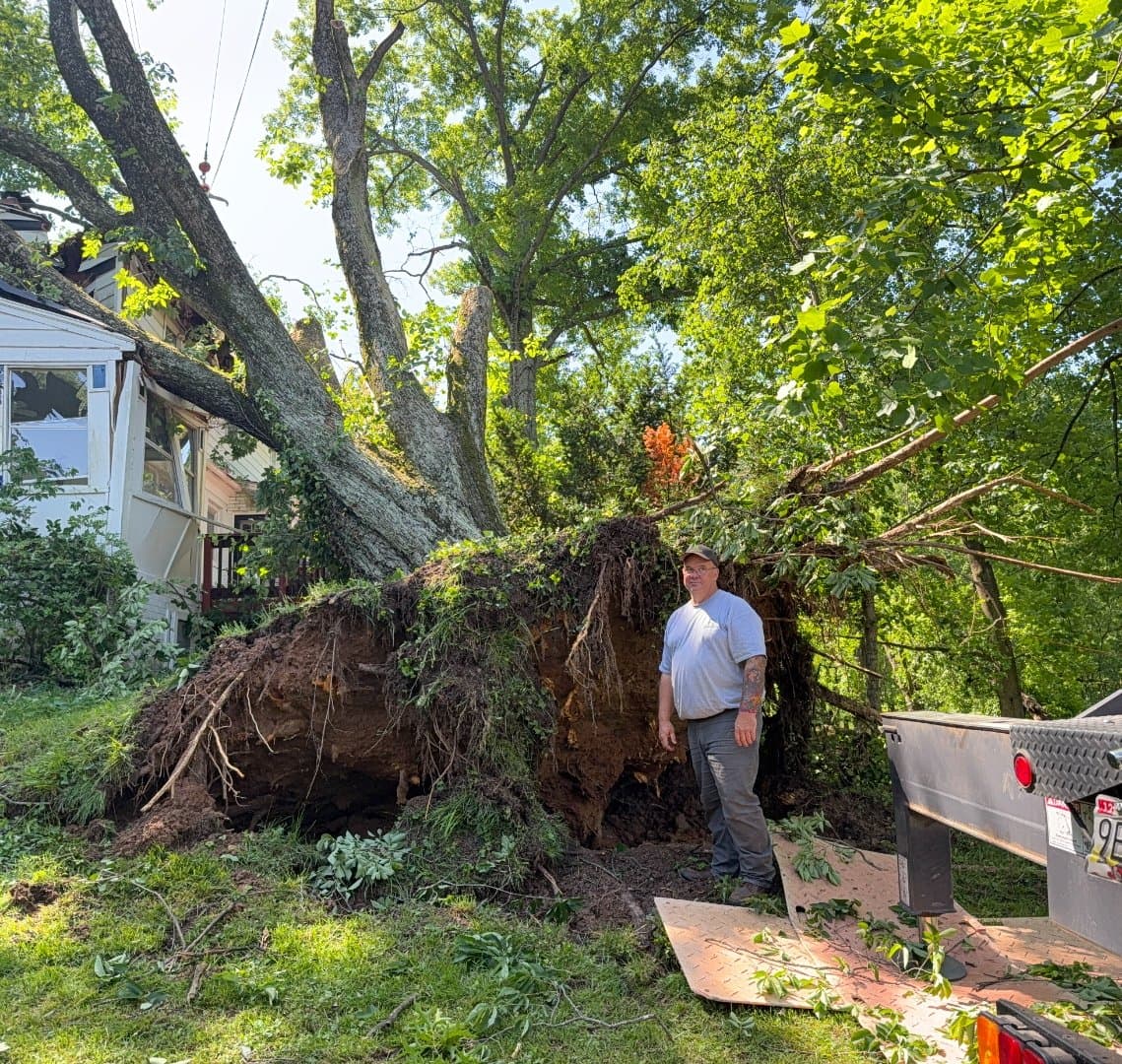
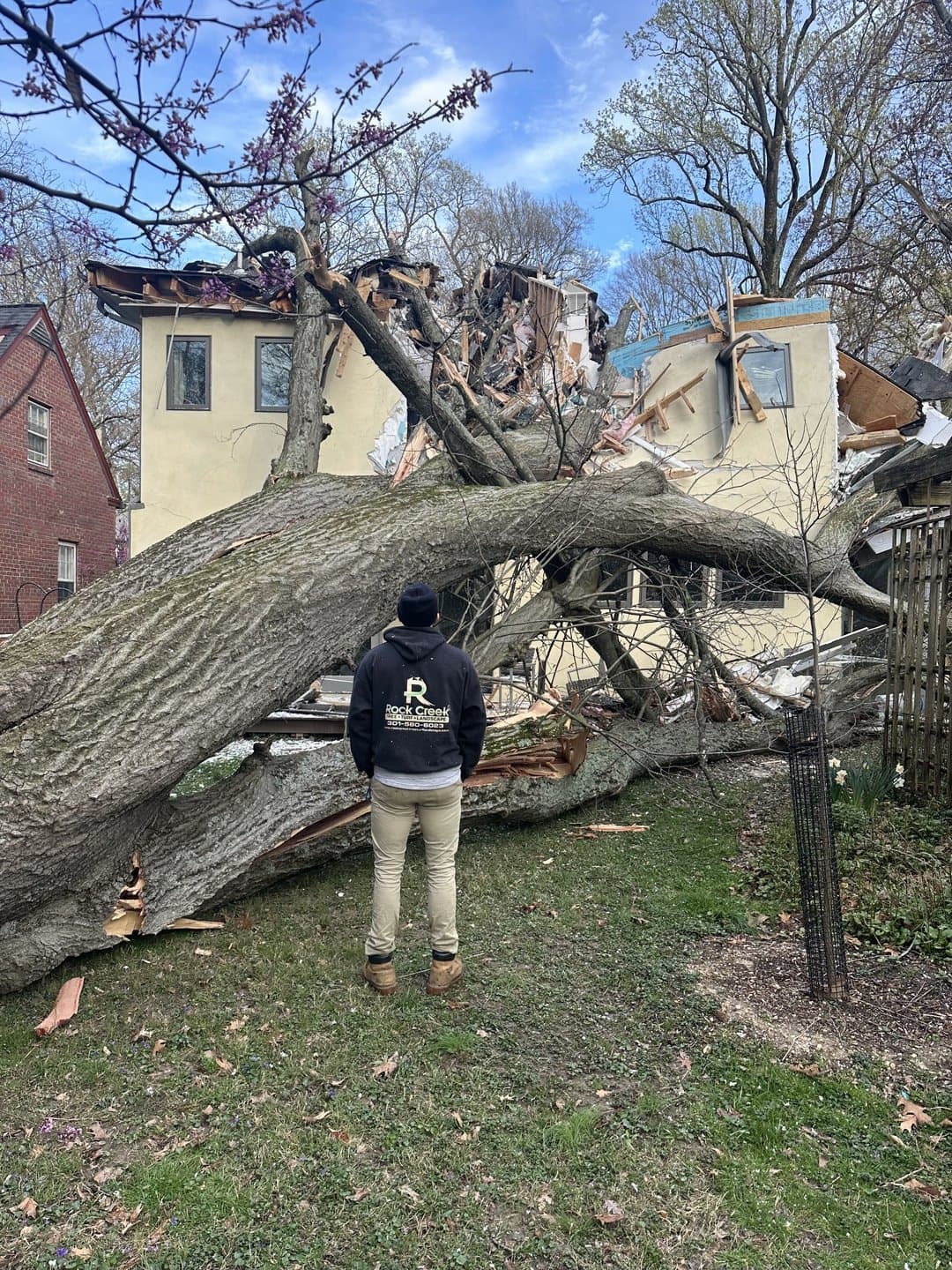
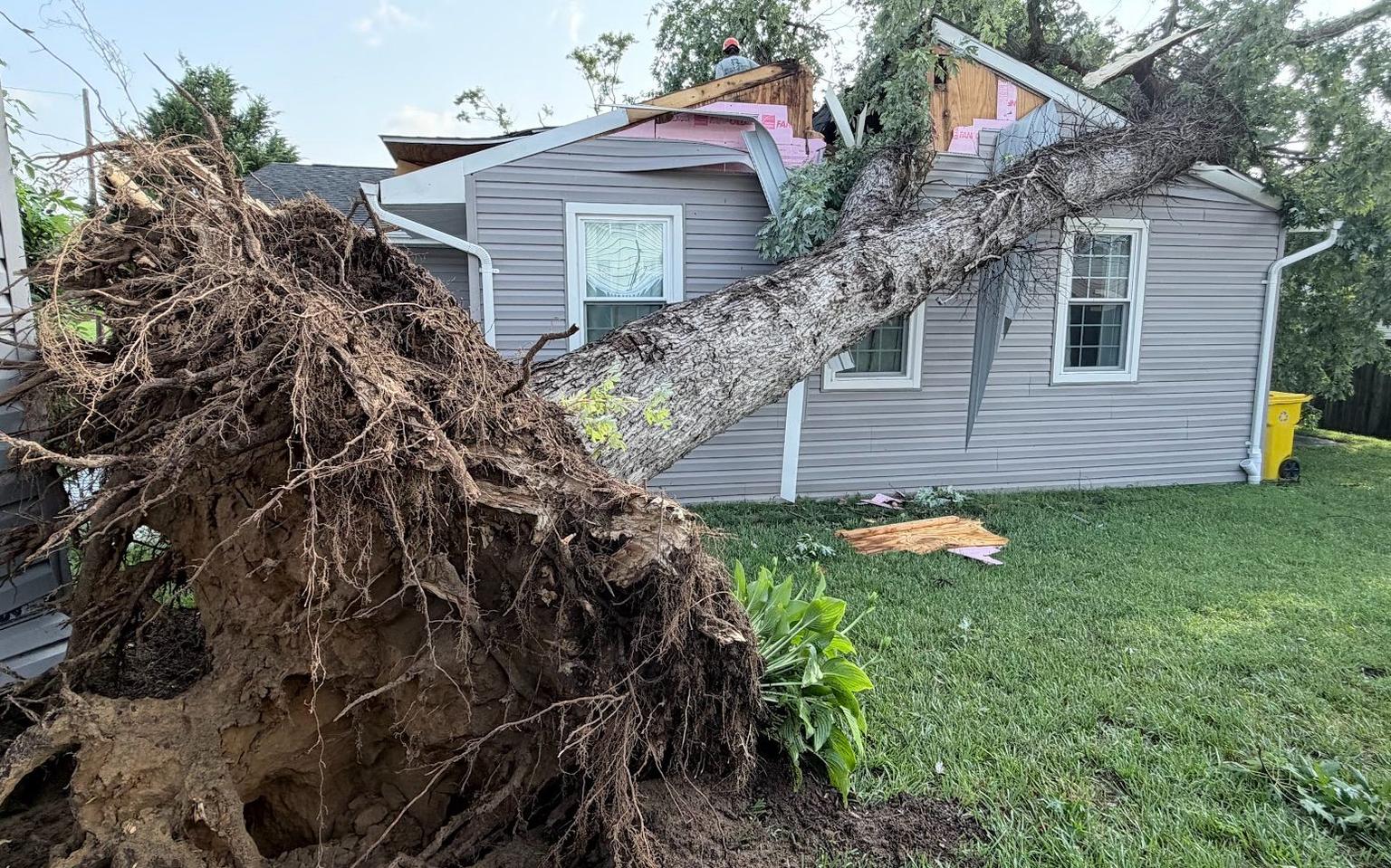
This photo shows a large tree that uprooted and fell across a home, leaving the root plate exposed. It illustrates why a tree’s roots, lower trunk and distance from structures are important parts of a tree assessment.
Uprooting can involve several factors, including wind, soil conditions and the condition of the roots. Root decay can contribute to a loss of support, but the photo alone does not establish whether decay or fungal activity caused this particular failure.
Warning signs homeowners should look for
Walk around mature trees periodically, especially trees that could reach a house or other frequently used area. Signs worth a closer look include:
- Mushrooms or shelf-like growth on the trunk, root flare or large surface roots.
- Cavities, soft or crumbling wood, missing bark, cracks or seams near the base.
- A new lean, soil lifting or fresh cracks in the ground around the roots.
- Large dead branches, thinning foliage or other changes in the crown.
- Recent trenching, construction or changes to soil around major roots.
Fungal growth may appear for a short time and then disappear. That does not necessarily mean the decay inside the tree has gone away. Trees can also have internal decay without visible mushrooms.
Does a tree with fungus need to be removed?
Not always. The right decision depends on the type and extent of decay, the condition of the roots and trunk, the size and lean of the tree, and what it could strike if it failed. Depending on the findings, options may include monitoring, reducing exposure beneath the tree, further evaluation or removal.
When to call an arborist about tree fungus
Call for an evaluation when mushrooms or shelf fungus are growing from the trunk, the root flare or major surface roots, particularly on a tree that could reach a house, driveway, deck or play area. Growth on an old stump or in mulch is a different matter, but if you are not sure what it is growing from, that is reason enough to have it looked at.
Treat a new lean, lifting soil, a major new crack or any other sign of movement as urgent. Stay away from the tree and the area it could reach and arrange a professional assessment right away. If there is immediate danger or a downed power line, call 911 and the utility. Do not approach the line.
How an arborist evaluates root and trunk decay
We begin by looking at the entire tree, including the crown, trunk, root flare and surrounding property. We also consider what lies within reach of the tree, such as a home, walkway, driveway or play area.
Depending on the situation, an arborist may sound the trunk with a mallet, inspect the root collar or recommend additional testing such as resistance drilling or sonic tomography. These tools help investigate decay, but no single photo or tool reveals every condition or guarantees how a tree will behave.
Request a free tree evaluation in Montgomery County
If you have noticed mushrooms, shelf fungus or other signs of decay on a tree in Bethesda, Potomac, Rockville, Olney or elsewhere in Montgomery County, Rock Creek Tree, Turf & Landscape can help. Our team includes ISA Certified Arborists and Maryland Licensed Tree Experts who can evaluate the tree and discuss practical next steps.
If it is safe to do so, share photos of the whole tree, its base and the fungal growth, and let us know how close the tree is to a house or other frequently used area. If the tree shows signs of movement, stay away rather than approaching for a picture.
Call 301-580-6023 or request a free on-site evaluation online. A formal written tree risk assessment is separate work and can be quoted on request.
Sources
UMass Extension on Berkeley’s polypore and root and butt rot. Missouri Department of Conservation on black-staining polypore and lookalikes. Colorado State University Extension on tree growth and decay.
Frequently asked questions
- Are mushrooms at the base of an oak tree dangerous?
- They can be a warning sign when they are growing from the trunk or major roots. Some mushrooms near a tree grow on buried dead wood instead. An arborist can examine the growth and the tree to determine whether further assessment is needed.
- Can a tree look healthy and still have root rot?
- Yes. Some trees keep green foliage while decay develops in their roots or lower trunk. Healthy-looking leaves alone do not rule out a structural problem.
- Will removing the mushroom or applying a spray fix the decay?
- Removing the visible fruiting body does not remove the fungus from the wood. A spray cannot restore wood that has already decayed. The first step is to evaluate the tree and decide how to manage the risk.