
Tree Service Questions, Answered
The questions we actually get asked on the driveway — answered the same way we answer them in person.
75 answers, grouped by the work they belong to. If your question is not here, call 301-580-6023 and ask — we would rather answer it than have you guess.
Tree Removal
Full tree removal page →- How do I know whether a tree actually needs to come down?
- The honest answer is that many trees people want removed can be saved, and some that look fine cannot. We assess structural condition, decay, root stability, lean and what is underneath the tree. Where pruning or cabling will solve the problem we say so — removal is the recommendation when the risk cannot be reduced any other way.
- Do I need a permit to remove a tree in Montgomery County?
- Sometimes. The City of Rockville, Takoma Park, the City of Gaithersburg and the Town of Chevy Chase all have their own tree ordinances, and historic districts add another layer. Elsewhere in the county, permits are usually tied to larger disturbances or construction rather than a single residential removal. We check what applies to your address before the work is scheduled, not on the day.
- What happens to the wood, the brush and the stump?
- That is agreed in the written estimate before we start. Standard removals include hauling all wood and brush off site and a full cleanup. Stump grinding is quoted separately because not everyone wants it — if you are replanting in the same spot you usually do. If you want rounds left for firewood or chips left for beds, say so and we will leave them.
- Will your equipment damage my lawn?
- We plan for it. Plywood matting under outriggers and along travel paths spreads the load so machines do not sink in or leave ruts, and tracked equipment spreads weight better than wheels. Saturated ground is the real limit — past a point it is better to move the job by a day than to churn up the yard.
- How long does a tree removal take?
- Most residential removals are a single day, and many are a half day. What extends it is access rather than size: a large tree in an open yard can be quicker than a medium one that has to be climbed and rigged out piece by piece over a roof. The estimate will tell you which yours is.
Tree Pruning & Maintenance
Full tree pruning & maintenance page →- When is the best time to prune trees in Maryland?
- Late winter to early spring for most species, while the tree is dormant — structure is visible, wounds close quickly once growth resumes, and insect and fungal pressure is at its lowest. Dead, broken and hazardous limbs come off at any time of year. Spring bloomers such as dogwood and cherry are pruned right after they flower.
- Why should oaks not be pruned in spring and early summer?
- Because of oak wilt. The beetles that carry it are drawn to fresh pruning wounds, and they are active here from roughly April through midsummer. Pruning oaks in the dormant season avoids that window entirely. If storm damage forces a cut during the risk period, the wound should be treated immediately.
- Can you just cut the top off to make my tree shorter?
- No, and no qualified arborist will. Topping removes the leaf area the tree feeds itself with, leaves large wounds that invite decay, and forces weak regrowth that is poorly attached and breaks in the next storm. Where a tree genuinely needs to be smaller, crown reduction cuts back to appropriate lateral branches and keeps the tree’s natural form and structure.
- How much can be taken off a tree at once?
- As a general rule, no more than about a quarter of the live canopy in a single season, and less than that on a mature or already stressed tree. Removing more than the tree can support pushes it into stress responses — water sprouts, dieback and vulnerability to pests.
- How often should mature trees be pruned?
- Most mature shade trees benefit from a look every three to five years, sooner if they overhang a roof, driveway or play area. Young trees are the better investment: structural pruning in the first ten to fifteen years builds good form and prevents the weak unions that cause expensive failures later.
Stump Grinding
Full stump grinding page →- What is the difference between stump grinding and stump removal?
- Grinding uses a cutting wheel to reduce the stump and its major surface roots to chips, typically several inches below grade, leaving the deeper root system to decay in place. Full removal excavates the root plate and leaves a large hole that needs backfilling. Grinding is faster, far less disruptive to the surrounding lawn, and is what almost every residential situation calls for.
- How deep do you grind?
- Deep enough for what you plan to do with the spot. Several inches below grade is enough to seed or sod over. If you intend to replant a tree in the same position, that needs to go deeper and wider, so tell us beforehand — it changes the approach.
- What happens to the grindings?
- Your choice. They can be left on site — they make usable mulch for beds, though they settle over time — or hauled away and the hole backfilled with soil so the area is level and ready to plant. Grinding produces a surprising volume of material, so it is worth deciding in advance.
- Can you grind a stump close to a patio, wall or fence?
- Usually, yes. What matters is whether the machine can physically reach it and what is buried nearby. Mark irrigation lines, invisible fencing, cables and septic components before we arrive — grinders cut through those as readily as they cut wood.
- Will the stump grow back if I leave it?
- The stump itself will not, but many species send up suckers from the remaining root system for years, and some — Norway maple and tree of heaven among them — are persistent about it. Grinding the stump and the major surface roots stops most of that. A stump left in place also draws carpenter ants and termites toward the house.
Crane Services
Full crane services page →- When does a removal actually need a crane?
- When the tree cannot be safely climbed, or when the pieces cannot be safely dropped. That covers dead and decayed trees that will not hold a climber, storm-damaged trees with limbs under tension, and healthy trees over a roof, pool, septic field or neighboring property where lowering by rope is not practical.
- Is crane work more expensive than a conventional removal?
- The machine costs more per hour, but it is often fewer hours and fewer people, and it removes the risk of damage that would cost far more than the job. On a tight site it is frequently the cheaper answer overall. The estimate compares the realistic methods for your tree rather than defaulting to the crane.
- Do you own your cranes or subcontract them?
- We own and operate our own crane equipment in-house, which is why we can commit to a storm-damaged tree quickly instead of waiting on a rental and an outside operator. We also run specialist access machines, including tracked spider lifts that reach into a back yard without needing a hard surface.
- Where does the crane have to be positioned?
- Somewhere with the reach and the footing for the lift, which is usually the driveway or the street, occasionally the lawn over matting, and sometimes a neighbor’s property with their agreement. Working that out is a large part of the site assessment — it decides whether the job is straightforward or needs a road closure.
- Will you need to close the road?
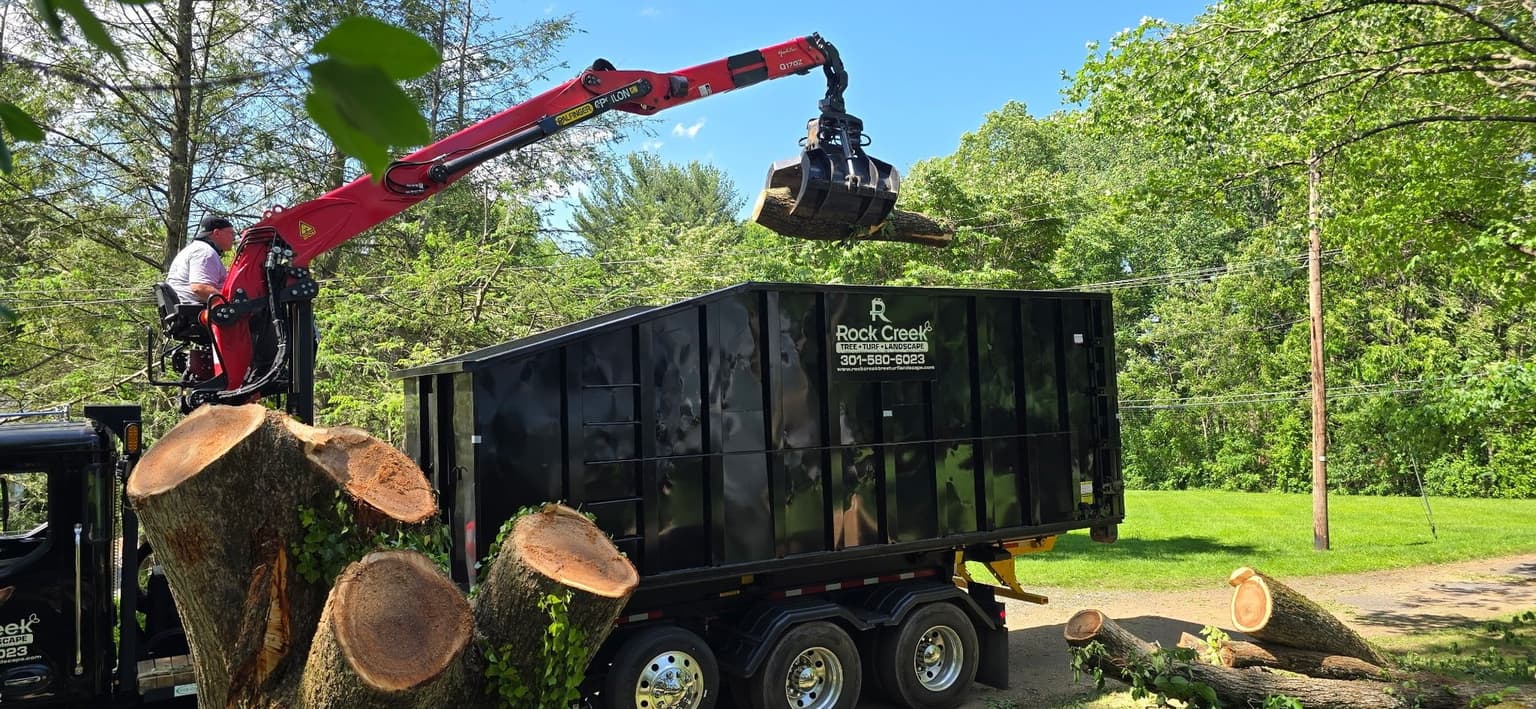
- Sometimes. It depends on reach, where material can be staged and how much traffic the street carries. Where a closure is needed we arrange it with the relevant local officials beforehand. Plenty of jobs that look like they need one do not, because our grapple truck can haul from the driveway.
Tree Planting
Full tree planting page →- When is the best time to plant a tree in Maryland?
- Fall is the best window here — roughly September through November. The soil is still warm enough for root growth while cooler air means less stress on the top of the tree, and winter moisture helps it establish before the first summer. Early spring is the second-best option. Midsummer planting is possible but needs committed watering.
- What should I plant in Montgomery County?
- Natives suited to our heavy clay soils and summer swings do best: white and red oak, red maple, tulip poplar, American hornbeam, serviceberry, bald cypress. What to avoid is as useful a question — Bradford pear, silver maple, Norway maple and Leyland cypress all cause more problems here than they are worth.
- How far from the house should a tree be planted?
- It depends entirely on mature size, not on the size of the tree you are buying. A large shade tree needs real distance from the foundation, the driveway, the septic field and the property line, and it needs to clear overhead lines at full height. Getting this wrong is the single most common planting mistake we see, and it is not fixable later.
- Why does planting depth matter so much?
- Because planting too deep is the most common way a new tree is quietly killed. The root flare — where the trunk widens into the roots — has to stay visible at the surface. Buried, it stays wet, the bark breaks down, and the tree declines over several years for reasons nobody connects back to planting day.
- How much water does a newly planted tree need?
- Deep, infrequent watering beats frequent light watering, because it draws roots downward. Through the first two growing seasons that generally means a thorough soak once or twice a week, adjusted for rainfall, and continuing until the ground freezes in the first fall. Established trees rarely need watering here except in drought.
Tree Feeding & Insect Control
Full tree feeding & insect control page →- Does my tree actually need fertilizing?
- Often not. A tree in decent soil with leaf litter left around it usually has what it needs, and feeding a tree whose real problem is root damage, compaction or drainage just wastes money. Where soil is genuinely depleted — common on newer construction where topsoil was stripped — targeted feeding helps. That is a question worth answering before treating.
- What insect problems are common on Montgomery County trees?
- Emerald ash borer, which has effectively removed untreated ash from the landscape; bronze birch borer; scale insects on maples and magnolias; bagworms on evergreens; and spotted lanternfly, which is now established across the region and congregates heavily on tree of heaven. Each needs a different treatment and, more importantly, different timing.
- Can you treat spotted lanternfly?
- Treatment is available, but the more effective step on most properties is removing the tree of heaven that draws them. Lanternfly prefers it strongly, and a property with mature tree of heaven will keep hosting large populations regardless of what is sprayed on the trees you care about.
- Is it safe around children and pets?
- Applications are carried out by Maryland-licensed pesticide applicators following the label, which specifies re-entry intervals and conditions. We tell you what is being applied, where, and how long to stay off the area before the work happens.
- When should trees be treated?
- Timing is most of the result. Many borer treatments have to go in before the insect is active, dormant oil is applied while the tree is dormant, and several pests have a narrow window when they are vulnerable. Treating at the wrong time often does nothing at all, which is why an assessment comes first.
Tree of Heaven Removal
Full tree of heaven removal page →- How do I know if I have tree of heaven?
- Long compound leaves with many leaflets, each with a small notch and gland near the base, and a strong unpleasant smell when a leaf or twig is crushed — often compared to rancid peanut butter. It grows very fast, has smooth grey bark when young, and turns up along fence lines, in alleys and at the edge of woods.
- Why is it such a problem?
- It spreads aggressively by seed and by root suckers, releases chemicals that suppress nearby plants, and is the preferred host of spotted lanternfly. A single mature tree of heaven on a property will keep producing both seedlings and lanternfly pressure across the whole neighborhood.
- Can I just cut it down?
- Cutting alone makes it worse. A tree of heaven cut at the base responds by sending up dozens of root suckers, often across a wide area and into neighboring yards, and you end up with a thicket instead of a tree. Effective control pairs removal with herbicide treatment so the root system is dealt with rather than triggered.
- How long does it take to get rid of?
- Expect follow-up. A properly treated tree usually needs monitoring over the following season or two, with any suckers treated as they appear. Anyone promising a single visit and a permanent result has not dealt with this species.
- Will it come back from a neighbor’s yard?
- It can. Root systems cross property lines and seed travels readily. If there is a mature tree of heaven next door, controlling your own is still worth doing, but it becomes ongoing management rather than a one-off. It is a conversation worth having with the neighbor.
Tree Inspection & Risk Assessment
Full tree inspection & risk assessment page →- What does an arborist look at during an inspection?
- Structural condition, signs of decay and disease, lean and root stability, the state of any existing cables or braces, deadwood sitting over things that matter, and how close the tree is to anything a failure would damage. On a wooded property the assessment is weighted toward the trees with something underneath them.
- I have just bought a wooded property. Where should I start?
- With the trees closest to the house, the driveway and anywhere people park or sit — that is where a failure actually costs you something. What a first visit gives you is not a list of defects but an order of operations, so the work can be spread across several seasons instead of done all at once.
- Can you tell if a tree is hollow or decayed inside?
- Often, from external indicators: fungal fruiting bodies, cavities, sounding the trunk, bark condition and canopy dieback. Extent matters more than presence — many trees live for decades with substantial internal decay. Where the picture is unclear or the consequences of failure are high, further investigation may be warranted.
- Is a tree that was struck by another tree still dangerous?
- It should be assessed. Impact can crack a stem or tear a branch union in ways that are not obvious from the ground, and the second tree is the one people routinely forget after a storm. We have removed trees left standing and structurally compromised after a neighboring tree came down onto them.
- When is the right time to have trees looked at?
- Before storm season rather than after it, and before any construction, regrading or trenching inside the root zone. Interior decay and root damage are not visible from a driveway, and a tree in full leaf looks healthy right up until it is not.
Storm Damage Cleanup
Full storm damage cleanup page →- My neighbor’s tree fell into my yard. Who is responsible for the cleanup?
- Usually the property the tree lands on handles it through their own policy, regardless of which yard it grew in, and the insurer may then pursue the neighbor if negligence is involved. In practice the fastest route is to get it cleared, keep the documentation, and let the carriers settle between themselves.
- Is storm cleanup covered by homeowners insurance?
- Often, when a covered peril brought the tree down and it damaged a structure. Debris removal where nothing was damaged is frequently excluded or capped. We document the work either way so you have what the adjuster asks for, but the coverage decision is your insurer’s.
- How soon should hanging limbs be dealt with?
- Promptly. A limb caught in a canopy can drop without warning and in still air, and it is the most common cause of injury in the days after a storm. Keep people and vehicles out from under it until it is down.
- Do you clear whole properties or just the tree that fell?
- Either. After a severe storm we will often clear a property end to end — down trees, hung limbs, broken tops, debris — and give you an assessment of the trees that are still standing at the same time.
- What happens to the wood and brush?
- Hauled off site as standard, and that is stated in the written estimate. If you want rounds left for firewood or chips left for beds, say so beforehand and we will leave them.
Hazardous Tree Removal
Full hazardous tree removal page →- How do I know if my tree is actually hazardous?
- Look for the combination rather than any single sign: a defect — dead wood, decay, a crack, a new lean, lifted soil — plus something underneath that a failure would damage. A defect over open lawn is worth monitoring. The same defect over a roof is worth acting on. An arborist visit settles it either way.
- Can a hazardous tree be saved instead of removed?
- Sometimes. Crown reduction can lower the sail area and the leverage on a weak stem, cabling can support a split union, and targeted pruning can remove the specific limb that is the problem. Removal is the answer when the risk cannot be brought down any other way.
- What if the tree is touching a power line?
- Do not approach it and do not let anyone else. Call the utility first — service drops and distribution lines are handled differently, and some of the work is theirs rather than ours. We coordinate with them where the tree work is ours to do.
- Why can a dead tree not just be climbed like any other?
- Because the wood has lost its strength and a climber cannot judge from the outside which limb will take their weight. Dead and heavily decayed trees are worked from a crane or a lift so nobody is relying on the tree to hold them.
- How quickly can a hazardous tree be removed?
- A tree that is actively unsafe — on a structure, leaning hard, or with a failed root plate — is assessed straight away and we respond around the clock. A tree that is a concern but stable is scheduled normally.
Cabling & Bracing
Full cabling & bracing page →- Will cabling stop my tree splitting?
- It substantially reduces the risk, and that is the honest way to put it. A correctly placed system limits how far two stems can move apart in wind, which is what tears a union open. It does not make the tree immune, and it does not repair a union that has already failed.
- How long does a cable last?
- Years rather than decades, and it depends on the hardware and how fast the tree grows. Systems need periodic inspection and eventual replacement. A cable left in a growing tree indefinitely can end up embedded and doing nothing.
- There is an old cable in my tree. Should I worry?
- It should be looked at. Old hardware loosens, corrodes or grows over, and a system nobody has checked is providing unknown support. On a recent Rockville job we repaired a damaged cable in a multi-stem tulip poplar during the same visit as a removal.
- Is cabling cheaper than removal?
- Usually, and it keeps a mature tree you cannot replace in under fifty years. But it is not free and it commits you to inspections. It is worth it on a sound, valuable tree with one structural weakness — not on a tree that is declining anyway.
- Can any tree be cabled?
- No. The tree has to be structurally sound apart from the union being supported, and it has to have enough good wood to anchor into. A decayed stem will not hold hardware, and we will tell you when that is the case.
Commercial Tree Services
Full commercial tree services page →- Do you provide certificates of insurance for property managers?
- Yes, issued directly from our insurer and naming your entity as required. Liability, workers compensation and auto. This is normally the first thing a property manager asks for and we expect the request.
- Can work be done outside business hours?
- Yes, and on commercial sites it often should be. Parking lots, entrances and drive aisles are far easier to work early, late or at a weekend, and it avoids closing off areas your tenants and customers need.
- Do you handle multiple properties under one arrangement?
- Yes. Portfolio work is usually more efficient for everyone — one inventory, one prioritized plan, and work batched so mobilization is not repeated for each site.
- What is a documented risk assessment for, on a commercial site?
- It establishes what a reasonable owner knew and when. If a limb comes down on a car and there is a record showing the tree was inspected on a cycle and the recommendations were acted on, that is a materially different position from having no record at all.
- How often should commercial trees be inspected?
- Annually is a sensible baseline for trees over high-traffic areas, with a look after any severe storm. Trees in low-consequence positions on the same site can go longer.
HOA Tree Services
Full hoa tree services page →- The tree is on the line between common area and a homeowner’s lot. Who pays?
- That is governed by your association’s documents rather than by us, and it is worth settling before the crew arrives rather than on the day. We are happy to assess the tree and quote the work regardless, and to talk to both the board and the homeowner.
- Can you provide something we can put in front of the board?
- Yes, and that is how we normally write HOA proposals. Urgent work separated from planned work, each item priced, so a board can approve part of it without approving all of it.
- How much notice do residents get?
- As much as you want them to have. Tell us your notice period and we will schedule around it. Work that closes parking or a path is worth flagging further ahead than work that does not.
- Do you do multi-year plans?
- Yes, and for a community of any size it is the sensible approach. Doing everything in one year is rarely affordable and rarely necessary — a phased plan keeps the high-consequence trees dealt with and spreads the rest.
- What about storm damage on common ground at 2am?
- We answer around the clock. For common areas, agreeing in advance who can authorise emergency work — and up to what figure — saves hours when it actually happens.
Municipal Tree Services
Full municipal tree services page →- Are you licensed for public tree work in Maryland?
- Yes. Maryland requires a Licensed Tree Expert for commercial tree work, and ours is #1944. We also carry ISA Certified Arborists on staff and full liability, workers compensation and auto cover, with certificates issued directly from our carrier.
- Do you arrange road closures yourselves?
- Yes, with the relevant local officials, as part of planning the job. On a recent Chevy Chase removal the closures were arranged before the day — that is how it should work, because sorting it on the morning is what turns a one-day job into two.
- Can you handle emergency road clearing after a storm?
- Yes, around the clock. Our own grapple trucks mean high volumes of material can be cleared without waiting on a separate haulage contractor.
- Do you provide tree inventories and condition assessments?
- Yes. For a public authority the inventory is usually the foundation for everything else — it establishes what is there, what condition it is in, and what the maintenance liability actually looks like over the next few years.
- How do you document work for public accountability?
- Tree by tree: what was inspected, what was recommended, what was done and when. It is the same discipline we use for insurance documentation, and it holds up to scrutiny after the fact.
Tree Preservation
Full tree preservation page →- How close can construction get to a tree before it is a problem?
- The usual rule of thumb is a protection radius of about one foot for every inch of trunk diameter, but it varies with species, age, soil and which side the roots are on. The only way to know for your tree is to have it looked at before the plans are fixed.
- My tree started declining two years after we built an addition. Is that related?
- Very possibly. Construction damage characteristically shows in the canopy two to four years later, which is exactly why it gets missed. Severed roots, compacted soil and grade change are the usual causes, and some of it can be mitigated even at that point.
- Can soil compaction be reversed?
- Partly. Compacted soil within the root zone can be decompressed and amended to get air and water moving again, and it does help. It is not as good as not compacting it, which is the argument for planning the machine routes before the machines arrive.
- Does Montgomery County require tree protection during construction?
- It depends on the jurisdiction and the scale of the disturbance. Rockville, Takoma Park, Gaithersburg and the Town of Chevy Chase all have their own ordinances, and larger disturbances elsewhere in the county can trigger requirements. We will tell you what applies at your address.
- Is it worth preserving every tree on a site?
- No, and we will say so. A tree already in decline, or one whose root zone the project genuinely cannot avoid, is often better removed and replaced than protected expensively and lost anyway. The judgment is which trees are worth the effort.
Still deciding?
Most of these questions have a different answer on a different property, which is why the estimate is free and done on site. An arborist walks the tree and the access route with you and tells you what it needs and what it will cost.
Got a question about a specific tree?
Send us photos and we’ll tell you what it will take — free estimate.