October 12, 2026
Can This Tree Be Saved? How the Decision Actually Gets Made
Not every damaged tree has to come down. What decides it, what can be done short of removal, and the point past which keeping a tree stops being a real option.
By John Ritz Miller, Jr. — ISA Certified Arborist MA-7241A, Rock Creek Tree, Turf & Landscape LLC
Published October 12, 2026
It is the question we get asked most often, and usually before anyone asks what it costs: does it have to come down? Behind it is a reasonable suspicion — that a company which removes trees for a living will find a reason to remove yours.
So here is how the decision is actually made, including the part where the answer is no, it does not have to come down, and what we do instead.
It is two questions, not one
“Is the tree damaged” is not the question. A hazardous tree is one where failure is both plausible and would matter, and both halves count.
A decayed tree at the back of a wooded lot with nothing underneath it is a monitoring job. The same tree, in the same condition, standing over a bedroom is urgent. Nothing about the tree changed — what changed is what it would land on. That is why the assessment starts with what sits underneath rather than with the tree itself.
It is also why two neighbors can get different recommendations for trees that look identical, and why both can be right.
What actually decides it
Extent of decay, not presence of decay
Finding decay does not condemn a tree. Many trees live for decades with substantial hollowing — a tree is a hollow cylinder structurally, and a surprising amount of the inside can be gone before the outside stops holding. What matters is how much sound wood is left and where it is.
That is also the honest limit of what any inspection can tell you from the ground. Fruiting bodies, cavities, bark condition, canopy dieback and how the trunk sounds are all readable from outside. The exact extent of internal decay is not. Where the picture is genuinely unclear, that is worth saying out loud rather than guessing in either direction.
Where the defect sits
A defect low on the main stem is a different proposition from the same defect out on a limb. A limb can be removed and the tree carries on. A compromised trunk carries everything above it, and there is no version of the job that takes the trunk out and leaves the tree.
Whether the load can be reduced
Much of what makes a defective tree dangerous is leverage and sail area — how much wind the canopy catches and how long the lever arm is above the weak point. Both can often be reduced. A tree that fails the assessment at its current size can sometimes pass it several feet shorter and thinner.
What can be done instead of removal
Where risk can be brought down without taking the tree, we say so. In practice that means one of four things, often in combination.
Crown reduction
Cutting sail area and leverage so there is less force on the weak point in the first place. This is not topping — we do not top trees, because a topped tree responds with fast, weakly attached regrowth and you inherit a worse problem in five years. Reduction shortens limbs back to appropriate lateral branches, which the tree can actually live with.
Cabling and bracing
The standard answer for a mature tree with two competing stems and a tight, included union — the defect that eventually splits, usually in a storm, usually taking half the tree with it. Flexible cable high in the canopy limits how far the stems can move apart; a threaded rod through the union itself is used where the crack has already started. This is explicitly work for a tree worth keeping.
One thing people are rarely told: this hardware has a service life. Cable installed twenty years ago loosens, corrodes and gets grown over, and almost nobody thinks to have it looked at until a stem fails. If you know there is a cable in one of your trees and do not know when it was last checked, raise it.
Taking the one problem limb
Often the whole recommendation. A single heavy horizontal limb over a roof, a drive or a patio can be the entire risk, and removing it leaves a sound tree with a slightly odd shape.
Monitoring
A real option, not a way of avoiding a decision. A stable defect that is not changing can be watched, as long as someone is actually watching it and knows what would change the answer. The thing to track is movement: a crack getting longer, wider or deeper is going in the wrong direction.
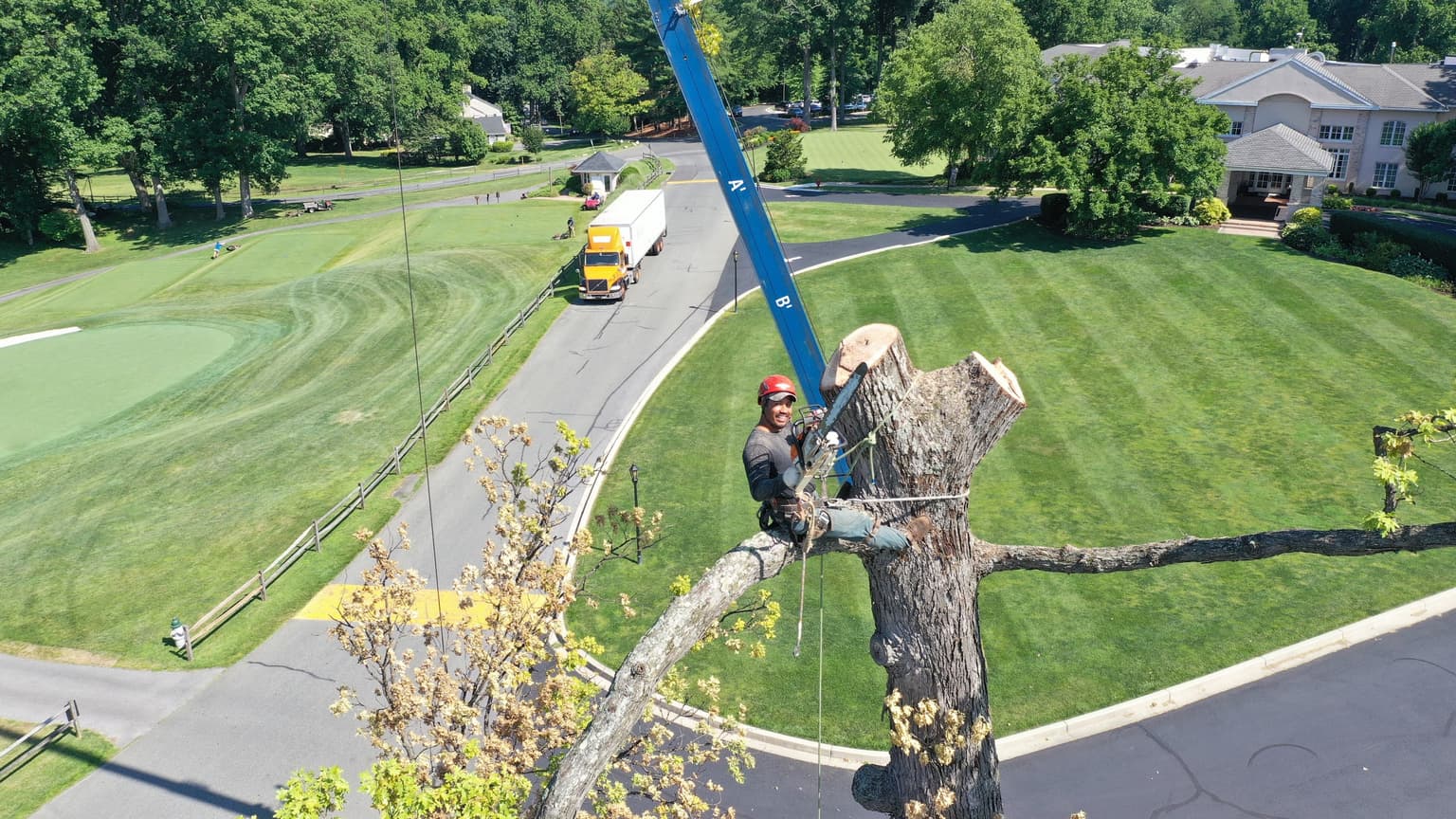
On a wooded Rockville property this autumn the plan that came out of the first inspection was exactly this mix — one dead oak removed, one failed cable repaired, and staged pruning afterwards rather than a clearance.
When the answer is removal
Removal is the recommendation when the risk cannot be brought down any other way. The recurring cases:
- A deep, active split in the main trunk, or a failing codominant union with included bark that has already started to come apart.
- Significant decay combined with a crack — either alone may be manageable, together they usually are not.
- More than roughly a quarter to a third of the canopy dead, which generally means the problem is in the roots or the vascular system rather than in the branches.
- Bark lost from more than about half the trunk's circumference, leaving too little functional tissue to sustain the tree.
- Roots already lifting out of the ground, or soil heaving and cracking at the base. Once the root plate is going, the tree is coming down one way or another — the only question is whether it is on your schedule or the weather's.
There is also a timing argument that cuts against waiting. A dead or failing tree gets more dangerous and more expensive to take down, not less: brittle wood cannot be climbed or rigged the same way, which pushes the job toward a crane. Removing a declining tree while it is still structurally sound is cheaper and safer than removing the same tree in two years.
The trees that are already lost and nobody knows yet
Worth naming because it is common and nearly invisible. Most mature trees that die after building work were not hit by anything. They were killed underground — roots severed by a trench, soil compacted by repeated machine traffic, grade changed by a few inches over the root plate — and the canopy did not show it for three or four years, by which point nobody connected the two events.
If you are planning an addition, a pool, a patio, a driveway or utility trenching anywhere near a mature tree, the time to ask whether it can be saved is before the machines arrive, not after the canopy thins. Protecting a root zone is far cheaper than replacing an eighty-year-old oak, which cannot really be done at all.
What to ask for
Whoever you have out, these three questions will tell you whether a real assessment happened:
- What would this tree hit if it failed? If nobody looked at what is underneath, nobody assessed the risk.
- What would have to be true for this tree to stay? A straight answer names the defect and what would reduce it — reduction, a cable, one limb — or explains why none of those gets there.
- If we do nothing, what changes, and how fast? A defect that is stable and a defect that is moving are different situations, and the answer should distinguish them.
A recommendation that cannot survive those three questions is a quote, not an assessment.
If you have a tree you would rather keep, say so at the estimate. It changes what we look for. Where there is a way to keep it, we would rather tell you that — a preserved mature tree is worth considerably more to the property than the removal fee is to us.
Frequently asked questions
- Will a tree company always tell me to remove the tree?
- It is a fair worry, and the test is whether the recommendation comes with reasoning. Where risk can be reduced without removal we say so — crown reduction, a cable on a weak union, or taking the single problem limb. Removal is the recommendation when the risk cannot be brought down any other way, and you should expect to be told which defect drives that.
- My tree is hollow. Does it have to come down?
- Not necessarily. Many trees live for decades with substantial hollowing, because a tree is structurally a hollow cylinder and a good deal of the inside can be gone before the outside stops holding. What matters is how much sound wood remains, where it is, and what the tree would hit if it did fail.
- Can cabling actually save a split tree?
- It can prevent a split on a tree that has not failed yet, which is the usual case — flexible cable high in the canopy limits how far two competing stems can move apart, and a threaded rod through the union is used where a crack has started. It is not a repair for a stem that has already come apart, and it is not permanent: the hardware has a service life and needs inspecting.
- How much of the canopy can be dead before a tree is past saving?
- As a general guide, more than roughly a quarter to a third of the canopy dead usually means the problem is in the roots or the vascular system rather than in the branches, and the odds of recovery drop sharply. One or two dead limbs on an otherwise full canopy is a pruning job, not a removal.
- Is it cheaper to save a tree than to remove it?
- Usually, yes — reduction, a cable or taking one limb costs less than a removal, and considerably less than removing the same tree after it has died and gone brittle. But cost is not the deciding factor. A tree that cannot be made safe should come down regardless of the price difference.
- We are building an addition near a big oak. Can it be protected?
- Often, if it is planned before work starts. The damage that kills mature trees during construction is underground — severed roots, compacted soil, a changed grade over the root plate — and it typically does not show in the canopy for three or four years. Establishing the root zone and protecting it before machines arrive is the whole job.