Tree Services
Tree Inspection & Risk Assessment in Montgomery County, MD
Certified arborist tree inspections and written risk assessments in Rockville, Bethesda, Potomac and Kensington, MD. Free on-site visit — 301-580-6023.
About Our Tree Inspection & Risk Assessment Services
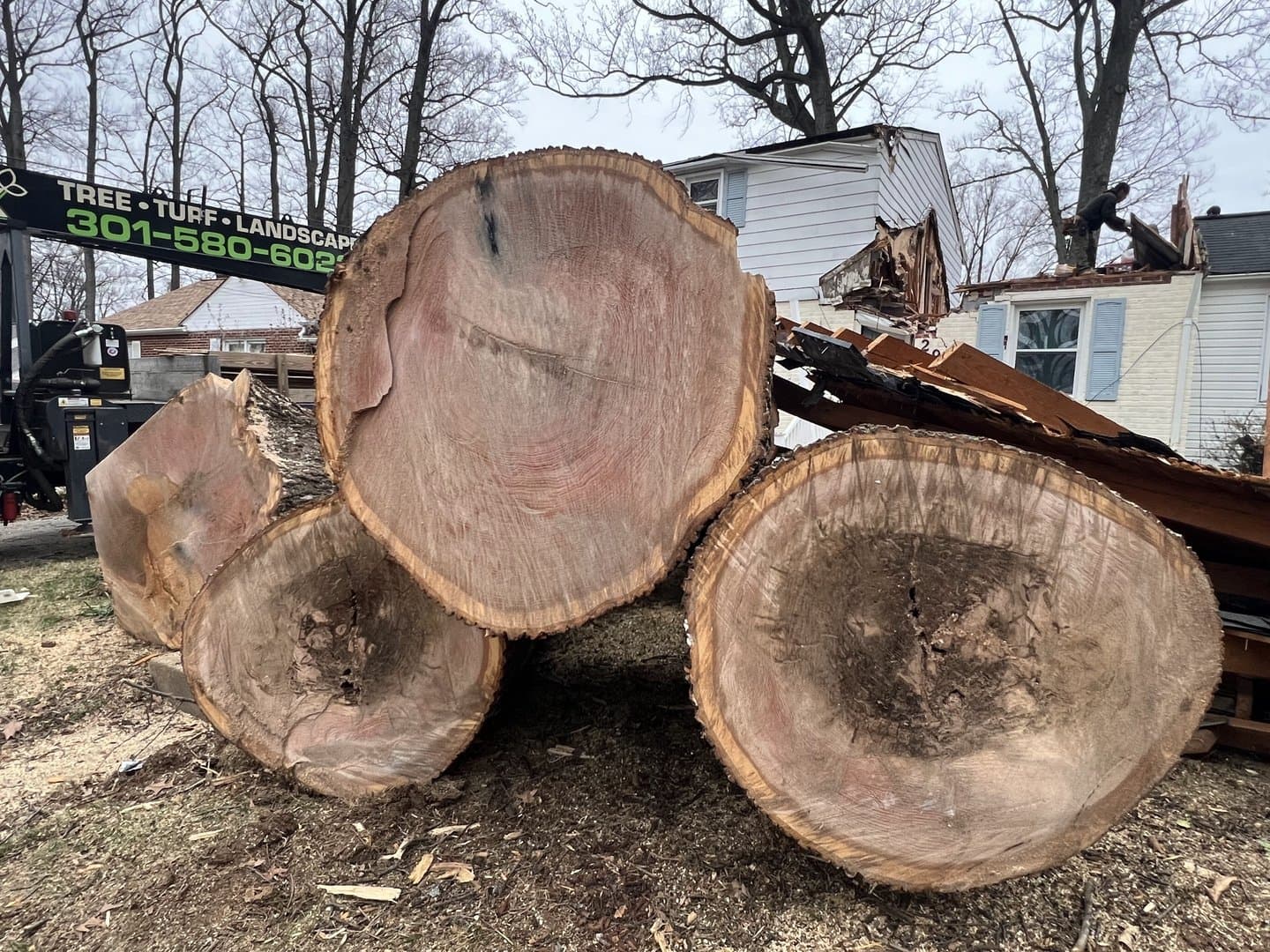
Most of the trees that come down on a house were showing something first. It is rarely dramatic: a large dead branch high in the crown, a crack running down the trunk, a fork where two stems press together with bark trapped in the union, soft wood and an open cavity at the base. An inspection is an ISA Certified Arborist walking the tree and the ground around it and telling you which of those things matter on your property and which ones do not.
Where the tree stands decides as much as the defect does. A dead top over a back lawn and the same dead top over a bedroom are not the same problem — one drops a limb into grass, the other drops it through a roof. So before recommending anything we look at what is underneath: the house, the driveway, the deck, the play set, the spot where a car sits every night. A defective tree over open lawn can often be left standing and watched. The identical tree over a walkway usually cannot.
Two different things get called an inspection, and it is worth knowing which one you need. A free on-site evaluation is a visit — an arborist looks at the tree, tells you what he sees, and quotes any work it needs. A formal written risk assessment is separate, billable work: a document setting out the tree’s condition, the risk it does or does not present, and the recommended treatment, in a form an insurance adjuster, a permit reviewer or a buyer’s agent will accept. The free visit is not that document. If the document is what you need, say so when you call and we will quote it.
When Homeowners Call Us For Tree Inspection & Risk Assessment
- Large dead branches in the crown, or a whole dead top, standing over a house, driveway, deck or parking spot
- A crack in the trunk or a main limb — particularly one running vertically, or one that has opened wider since you last looked at it
- A fork where two stems press tightly together with bark trapped in the union, on a tree big enough to reach something
- Soft or crumbling wood, an open cavity, or mushrooms and shelf fungus at the base or over a root
- A lean that has changed — the tree is sitting at an angle it was not sitting at a year ago
- Soil cracked, heaving or lifted on one side of the trunk, especially after high wind or a long wet stretch
- An insurer, a buyer, an HOA or a neighbor asking for something in writing about a tree
Our Process
Free on-site evaluation
An ISA Certified Arborist comes out, walks the tree and the property around it, and tells you plainly what he sees. No charge for the visit, and no obligation to have work done afterward.
The tree, crown to root plate
Deadwood and broken limbs in the crown, cracks in the trunk and main limbs, forks with included bark, decay and cavities, and the root plate and the soil over it. From leaf drop through early spring this gets easier: deadwood, cracks and bad unions that summer foliage hides are obvious against a bare sky.
What the tree stands over
A defect only matters in relation to what it can hit and how often somebody is under it. We record the targets — roof, driveway, walkway, deck, play area, parked cars — because that is what turns the same crack into "monitor it" on one property and "take it down" on the next.
Written risk assessment, on request
If you need it in writing, that is a separate billable piece of work and we quote it up front. The report sets out the tree’s condition, the risk it does or does not present, and the recommended treatment, in a document an insurer, an HOA, a permit reviewer or a buyer will accept. Ask for it when you call.
Why Hire Rock Creek for Tree Inspection & Risk Assessment
- ISA Certified Arborist on site — John Ritz Miller, Jr.
- Maryland Licensed Tree Expert #1944
- Fully insured — workers comp + liability + auto
- We will tell you when a tree is sound and needs nothing done to it
- Written risk assessments for insurers, buyers, HOAs and permit applications, available on request
- If work is needed, our own crews do it — no handoff to a subcontractor
Service Area
We provide tree inspection & risk assessment services throughout Montgomery County, Maryland and into Northern Virginia — including Arlington, VA, Aspen Hill, MD, Bethesda, MD, Brookeville, MD, Cabin John, MD, Chevy Chase, MD, Columbia, MD, Darnestown, MD and more.
Tree Inspection & Risk Assessment guides from our team
Record Heat and Midweek Storms in Montgomery County | Why Your Trees Are at Peak Risk Right Now
Maryland opened September 10–15 degrees above average with storms forecast for Wednesday night.
Spotting Hazardous Trees After the June Storms in Montgomery County
After the deadly June storms in Montgomery County, learn how to spot a hazardous tree before it falls, why saturated soil raises the risk, and when to call a licensed tree expert in Rockville, Bethesda, Potomac and Silver Spring.
Mature Tree Care in Rockville, Potomac & Bethesda, MD
Have large or older trees on your property? Learn when Rockville, Potomac, Bethesda, and Chevy Chase homeowners should schedule pruning, tree removal, stump grinding, or an arborist inspection.
Tree Inspection & Risk Assessment Services — common questions
- What does an arborist look at during an inspection?
- Structural condition, signs of decay and disease, lean and root stability, the state of any existing cables or braces, deadwood sitting over things that matter, and how close the tree is to anything a failure would damage. On a wooded property the assessment is weighted toward the trees with something underneath them.
- I have just bought a wooded property. Where should I start?
- With the trees closest to the house, the driveway and anywhere people park or sit — that is where a failure actually costs you something. What a first visit gives you is not a list of defects but an order of operations, so the work can be spread across several seasons instead of done all at once.
- Can you tell if a tree is hollow or decayed inside?
- Often, from external indicators: fungal fruiting bodies, cavities, sounding the trunk, bark condition and canopy dieback. Extent matters more than presence — many trees live for decades with substantial internal decay. Where the picture is unclear or the consequences of failure are high, further investigation may be warranted.
- Is a tree that was struck by another tree still dangerous?
- It should be assessed. Impact can crack a stem or tear a branch union in ways that are not obvious from the ground, and the second tree is the one people routinely forget after a storm. We have removed trees left standing and structurally compromised after a neighboring tree came down onto them.
- When is the right time to have trees looked at?
- Before storm season rather than after it, and before any construction, regrading or trenching inside the root zone. Interior decay and root damage are not visible from a driveway, and a tree in full leaf looks healthy right up until it is not.
Need tree inspection & risk assessment today?
Call us 24/7 or request a free quote online.