September 28, 2026
Tree Inspection and Oak Removal Beside a Septic Field in Rockville
New Rockville homeowners wanted their wooded lot assessed. How we removed a dead oak over a septic field by crane and set a plan for the mature trees.
By John Ritz Miller, Jr. — ISA Certified Arborist MA-7241A, Rock Creek Tree, Turf & Landscape LLC
Published September 28, 2026
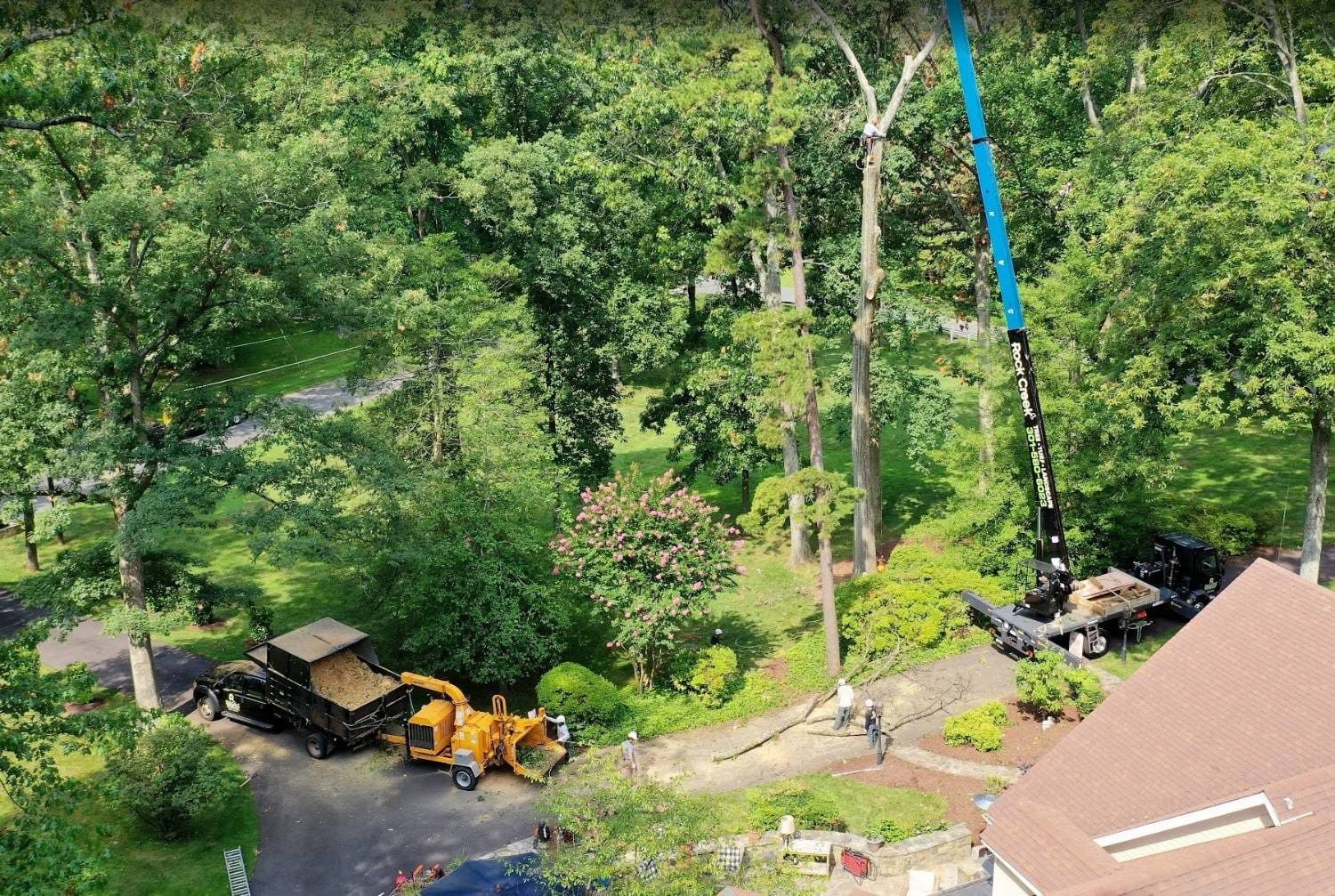
The mature trees were one of the reasons these homeowners bought the place. A wooded lot near Holly Ridge Road in Rockville, in the Flower Valley area — the kind of canopy that takes eighty years to grow and about an afternoon to lose if nobody is paying attention.
Having moved in, they wanted to know what they had actually taken on. Some maintenance had been let slide by the previous owner, and one thing was obvious enough to worry about without any expertise at all: a visibly dead oak standing right next to the septic system.
Neighbors on the Flower Valley listserv gave them our name. They called the office and we arranged for an arborist to walk the property with them — which is the part that matters. Not a quote posted through the door; a walk round, together, with the people who own the trees.
Starting where the consequences are
The lot carries an impressive mix of mature native shade trees: white oaks, red oaks, black oaks, tulip poplars and black locusts. That is a lot of tree to assess in one visit, so the arborist and the homeowners started where a failure would cost the most — the trees closest to the house and the driveway.
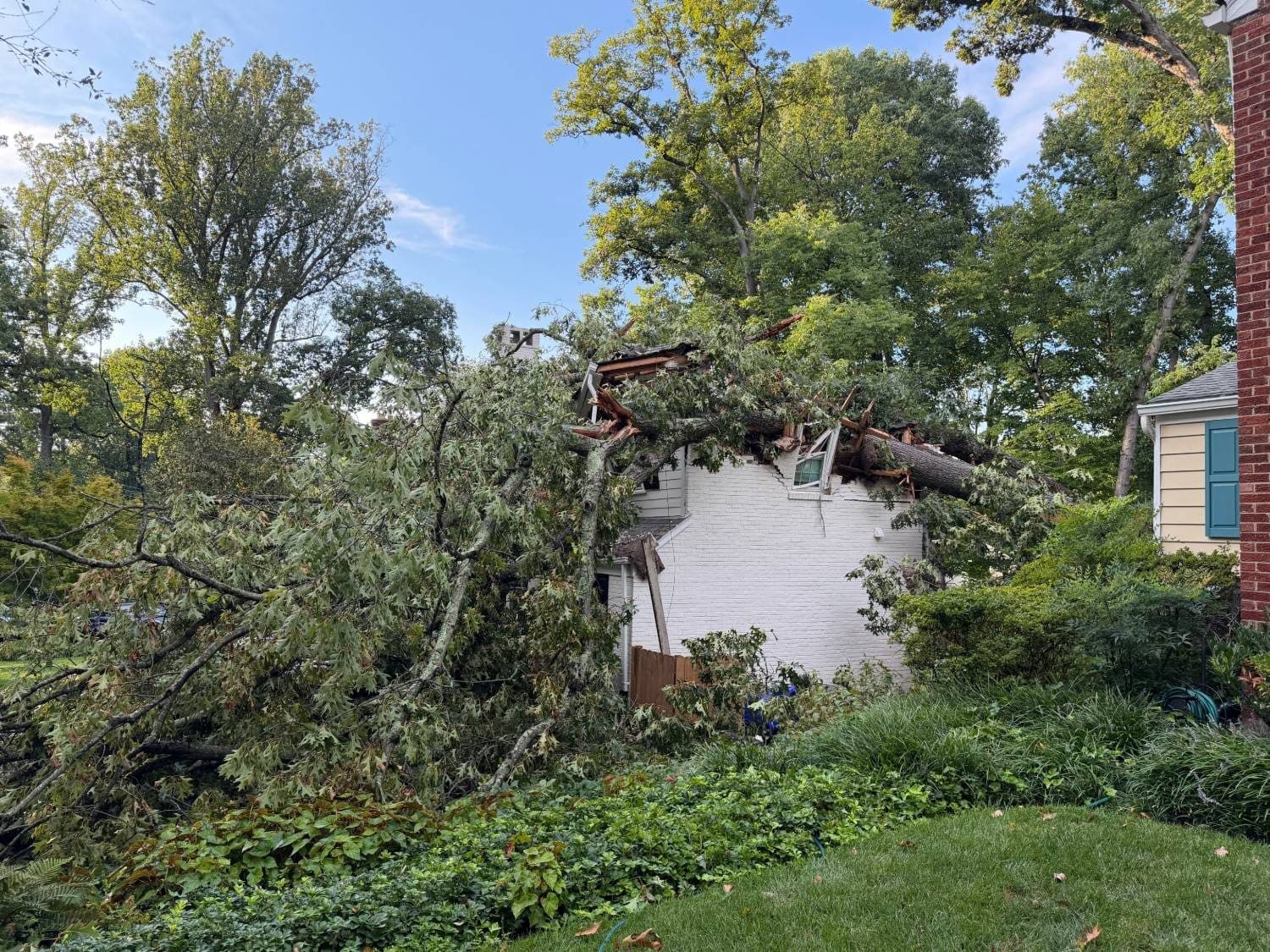
This is the sensible way to triage a wooded property. A declining tree at the back of a two-acre lot with nothing under it is a different problem from the same tree leaning over a roof, and treating them as equally urgent is how homeowners end up spending money in the wrong order.
Most of the trees were in good condition. Several needed maintenance pruning, chiefly to take out large dead branches reaching over the roofline. The visit gave the homeowners something more useful than a list of problems — it gave them an order of operations: deal with the dead oak, repair an existing support cable, and plan the rest of the pruning and monitoring over time.
An oak removal planned around a septic field
The dead oak stood near the driveway with the septic tank and leach field around its base. The tree had taken significant damage to its root system at some point, which may well be what put it into decline. Whatever the cause, its condition called for removal — and what was underneath it decided how that removal could be carried out.
Before work like this we ask the homeowner to identify where the septic tank and field actually are. Not approximately. Knowing where those components sit is what lets us protect the property, plan equipment access and keep the crew safe, and we do not begin work near a septic system without that information. A drain field is not visible, it does not tolerate point loads, and replacing one is an expense that dwarfs any tree job.
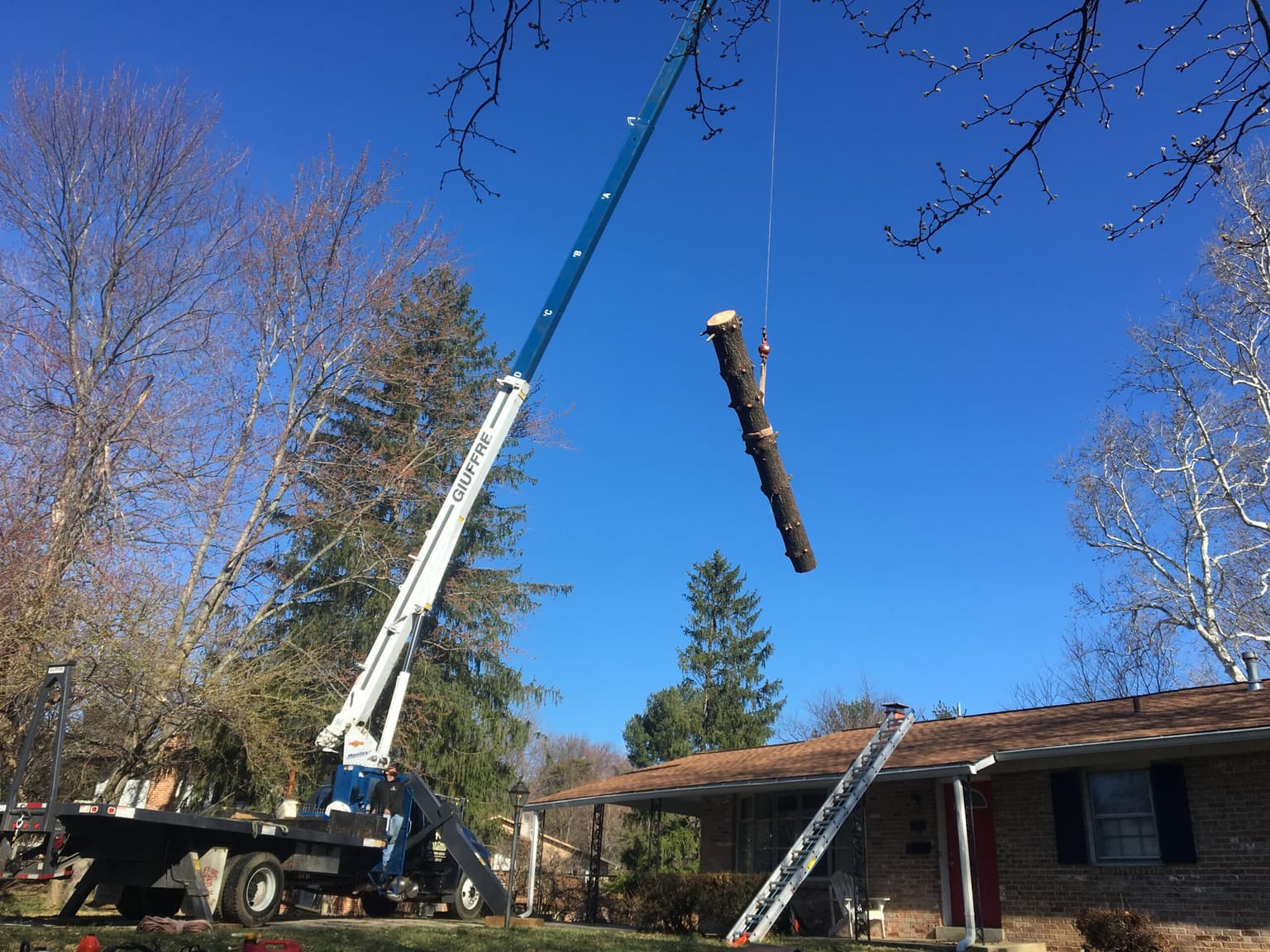
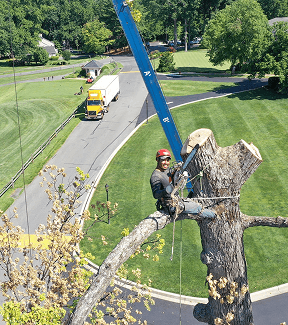
The constraint was simple to state and awkward to satisfy: large pieces of wood could not be dropped anywhere near the tree. So the crew used a crane. Climbers worked up through the canopy methodically — rigging manageable sections, making controlled cuts, and having each piece lifted away to somewhere it could be set down without ever landing on the ground above the system.
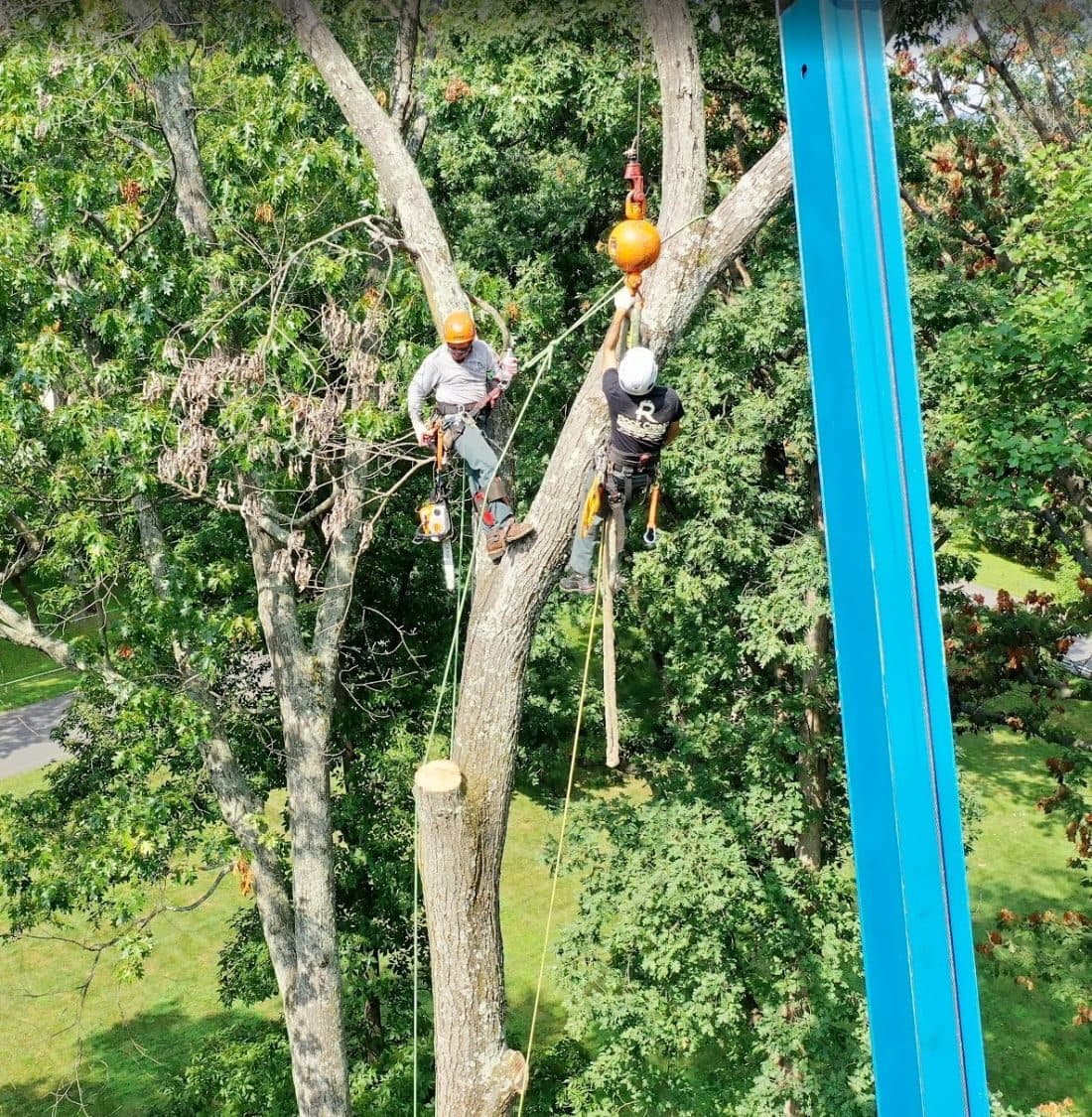
The removal went smoothly. Because the stump sat in a mulch bed rather than in lawn, the homeowners chose to have it cut flush with the ground instead of ground out — a reasonable call when nothing is going to be mown over it and nothing is being replanted in that spot.
A cable repaired, and a plan for the rest
While the crew was on site they also repaired a damaged support cable in a multi-stemmed tulip poplar behind the patio. Multi-stem trees of that size often carry hardware installed years earlier to hold competing stems together, and that hardware has a service life — it needs inspecting and occasionally replacing, which almost nobody thinks to do until a stem fails.
The homeowners took the priority items first and are budgeting for the additional pruning and maintenance later. That is a perfectly good way to do it. The wooded setting they bought the house for is still the defining feature of the property; what they have now is a clear picture of its condition, the dead oak gone, and a plan for the mature trees that remain. They intend to have us back as they work through the rest of the recommendations.
What a first inspection is actually for
If you have recently bought a wooded property, the value of an arborist visit is not really the list of defects. It is the sequencing. On this job it came down to:
- Which trees could hurt something if they failed — the ones near the house and the driveway got looked at first, and the back of the lot can wait.
- What has to happen now versus what can be budgeted — one dead oak and one failed cable now; pruning in stages afterwards.
- What is hiding underground — the septic field did not change whether the oak came down, but it completely changed how, and it would have been a very expensive thing to discover halfway through.
- What the previous owner left behind — deferred pruning and ageing support hardware both transfer with the deed, and neither shows up on a home inspection.
Interior decay, root damage and tired cabling are not things you can assess from a driveway, and a tree in full leaf will look healthy right up until it is not.
Book an assessment for your own trees
If you have bought a wooded property in Rockville, Flower Valley, Olney or elsewhere in Montgomery County and want to understand what you have, we will walk it with you and tell you what needs doing and in what order. There is more on looking after established trees in our guide to mature tree care.
If something already concerns you — a dead limb over the roof, a lean that looks new, a tree near a septic field or a well — send us photographs and we will tell you whether it needs attention.
Frequently asked questions
- Can a tree be removed if it is standing over a septic field?
- Yes, but the method changes completely. Heavy wood cannot be dropped onto the ground above a tank or a leach field, so on this job the crew used a crane to lift each rigged section clear and set it down elsewhere. The first requirement is knowing exactly where the components are — we do not start work near a septic system until the homeowner has identified their locations.
- Why do you need to know where my septic tank and drain field are?
- Three reasons: protecting the system from point loads that can crush or compact it, planning where equipment can safely be positioned, and crew safety. A drain field is invisible from the surface and replacing one costs far more than any tree work, so this is not a formality.
- Should I grind the stump or have it cut flush?
- It depends what happens to that spot afterwards. Grinding is the answer if you are going to mow over it, replant, or want the roots to break down faster. On this job the stump was in a mulch bed, so the homeowners chose a flush cut — nothing was going to be mown there and nothing was being replanted.
- I just bought a house with a lot of mature trees. Where do I start?
- With the trees closest to the house, the driveway and anywhere people sit or park, because that is where a failure actually costs you something. A walk round with an arborist gives you a priority order rather than a list, which is what lets you spread the work over several seasons instead of doing it all at once.
- What does an arborist look at during a property inspection?
- Structural condition, signs of decay or disease, lean and root stability, the state of any existing hardware such as cables and braces, deadwood over targets like roofs and driveways, and proximity to things that would be damaged by a failure. On a wooded lot the assessment is normally weighted toward the trees with something underneath them.
- There is a cable in one of my trees. Does it need attention?
- Probably at some point. Support cables and braces are installed to hold competing stems in a multi-stem tree, and they have a service life — hardware loosens, corrodes, or gets grown over. On this job a damaged cable in a multi-stemmed tulip poplar was repaired during the same visit. If you know you have one and do not know when it was last checked, that is worth raising.
- Can root damage kill a mature oak?
- It certainly can contribute. The oak on this property had taken significant damage to its root system, which may have been a factor in its decline. Roots are commonly injured by trenching, regrading, compaction from vehicles or construction, and the effect often appears in the canopy some years later — which makes the cause easy to miss.
- Do you charge for a tree inspection?
- Get in touch and we will tell you what the visit involves for your property before anything is scheduled, so there are no surprises either way.