September 28, 2026
Storm-Damaged Catalpa Removal Near Quincy Street in Chevy Chase
A split, uprooted catalpa leaning on a new garage in Chevy Chase, taken down by crane and spider lift from a property line with almost no room to work.
By John Ritz Miller, Jr. — ISA Certified Arborist MA-7241A, Rock Creek Tree, Turf & Landscape LLC
Published September 28, 2026
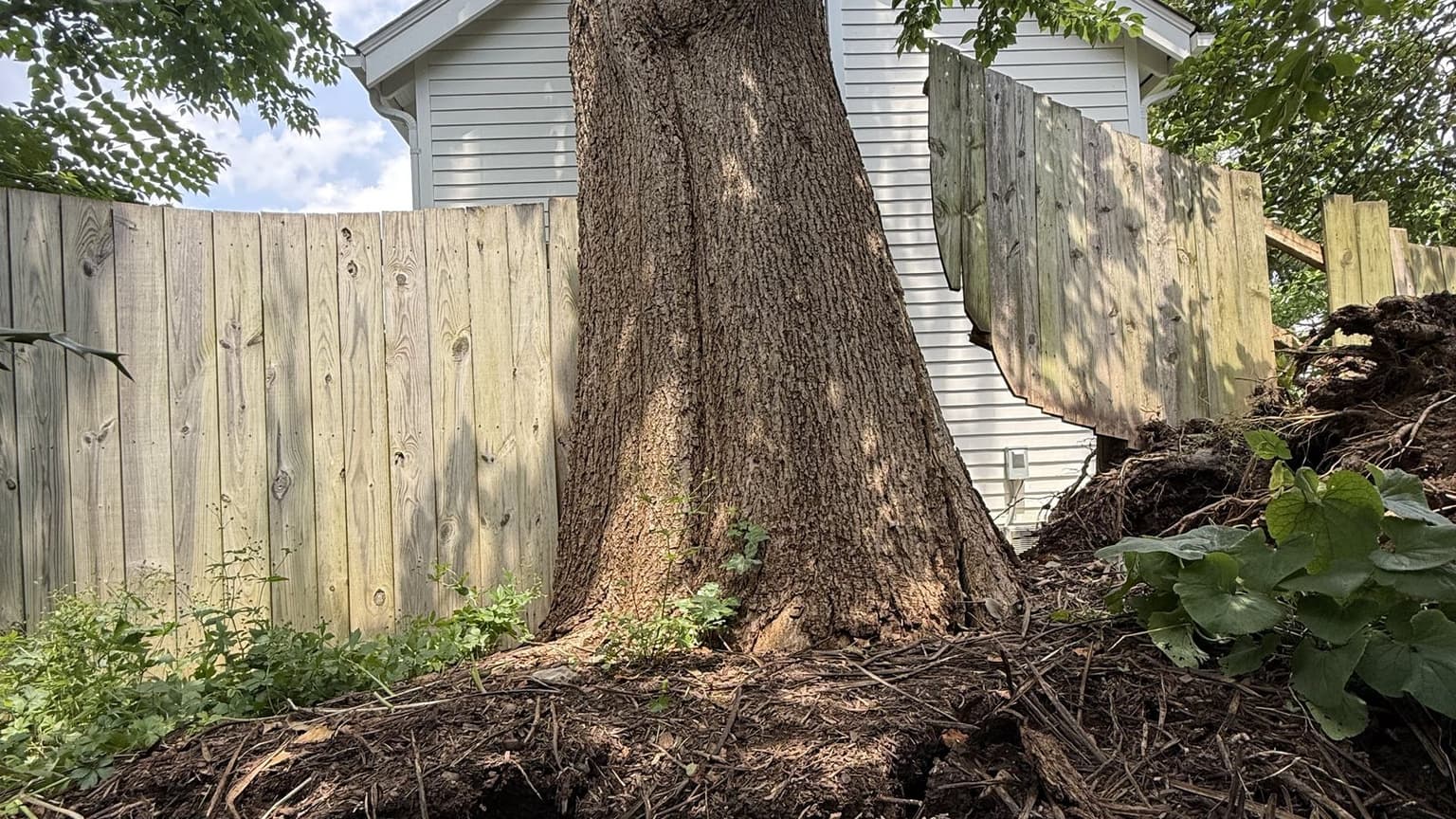
Severe storms came through Bethesda and Chevy Chase in June 2025. On a property line near Quincy Street they took apart a large multi-stemmed catalpa. One stem went down into the neighboring yard. The other — between 35 and 40 inches through — split at the trunk, lifted its root plate almost clear of the ground, and came to rest leaning on a newly finished detached garage.
The garage was holding the tree up. That is the detail that set everything else about this job, because it meant the structure could not simply be worked around — it was load-bearing until the weight above it was gone.
This is what that looked like when we arrived. The mound in the foreground is the root plate, heaved above the original grade, and the fence behind the trunk has been pushed out of line and broken where the roots came up.
A shared tree with very little room to work
The catalpa stood on the property line, so the work involved more than one household from the outset. Access had to be agreed with the neighboring owner before anything could be planned, and the site itself offered almost nothing to work with: retaining walls, a narrow driveway alley, tight roadways, passing traffic, and a small area where cut sections could actually be handled and processed.
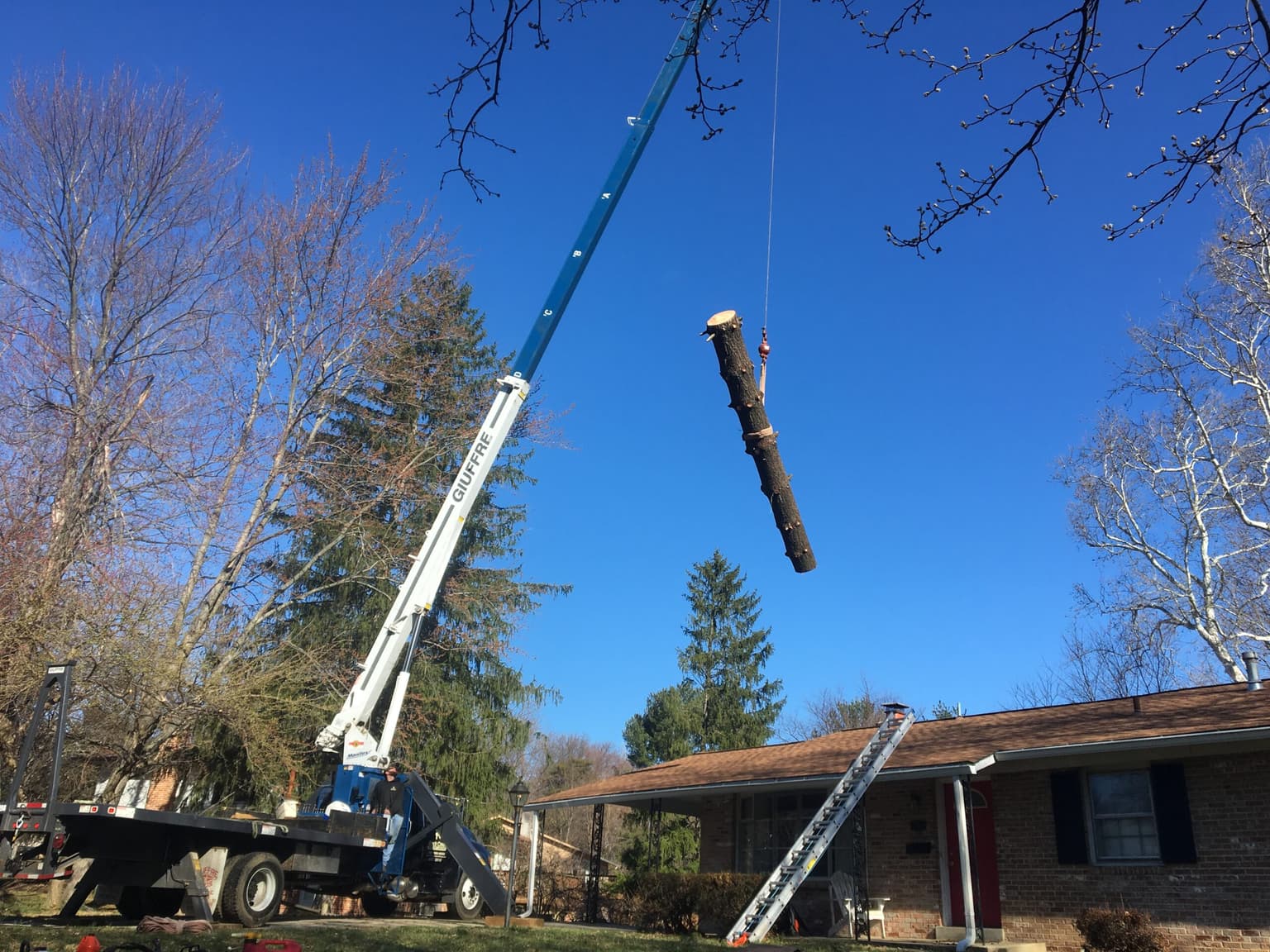
Those constraints chose the equipment rather than the other way round. One of our crane trucks has a footprint narrow enough to enter the driveway alley beside the house, and it was staged on the customer’s property over plywood matting to spread its weight and protect the ground underneath.
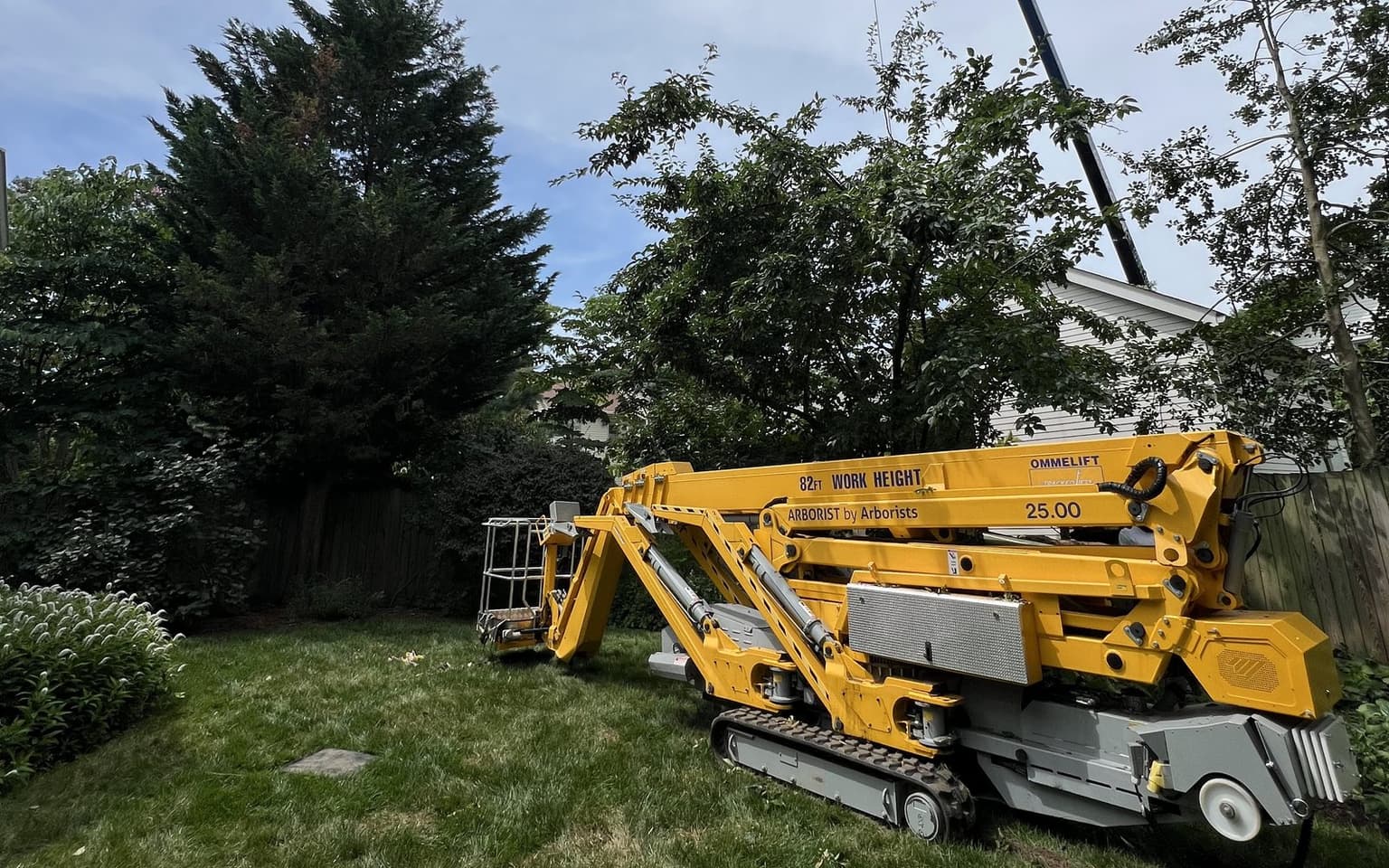
The second machine went in from the neighbor’s side: an 82-foot tracked spider lift, which puts a working platform up into a canopy without needing a hard surface or a wide approach to get there. We also arranged the road closures the operation needed with the relevant local officials.
A controlled removal from the top down
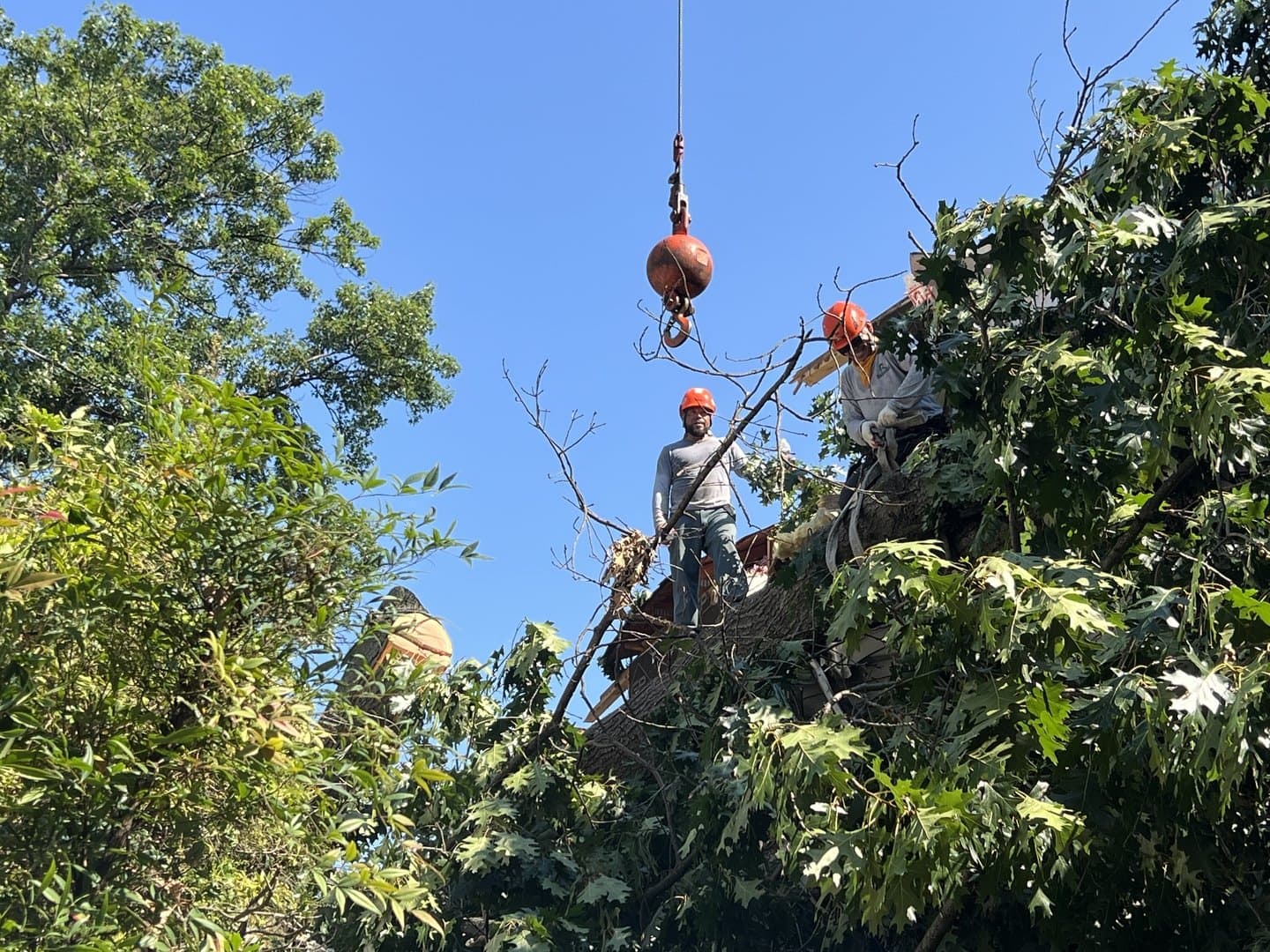
With the tree partly uprooted and resting on the garage, every cut had to account for how what remained would move once the weight came off. The crew worked from the top down, the crane taking small, manageable pieces of canopy away in a planned sequence. The narrow handling area meant dismantling the tree into smaller sections than an open site would ever require — more picks, more time, and far less load swinging over a structure at any moment.
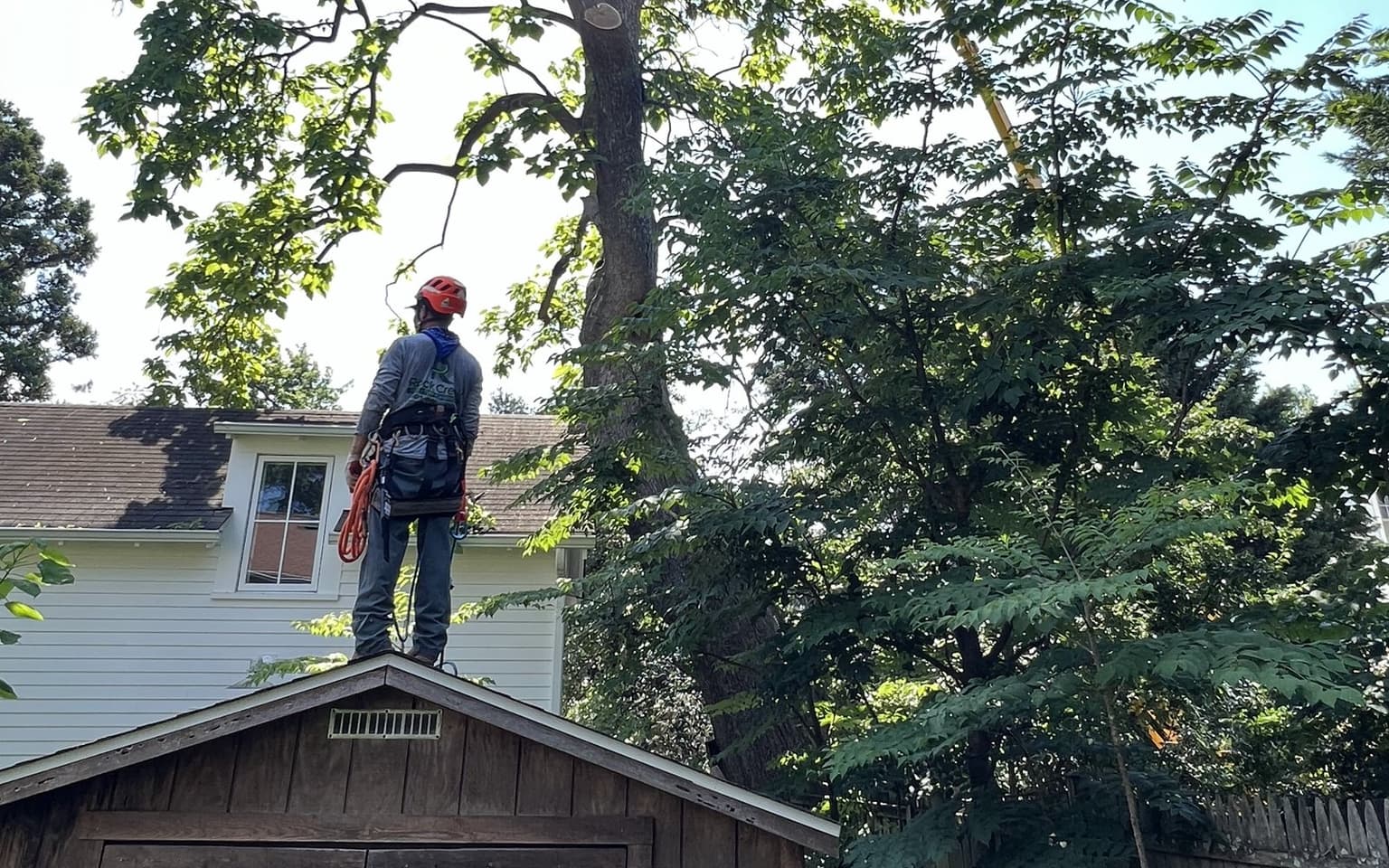
A large ground crew laid the protective matting and kept cut material moving out through the limited space, which is what stops a small handling area becoming the bottleneck that strands a half-dismantled tree overnight. They worked through the heat until the tree was down and the property was safe. All wood was hauled off site.
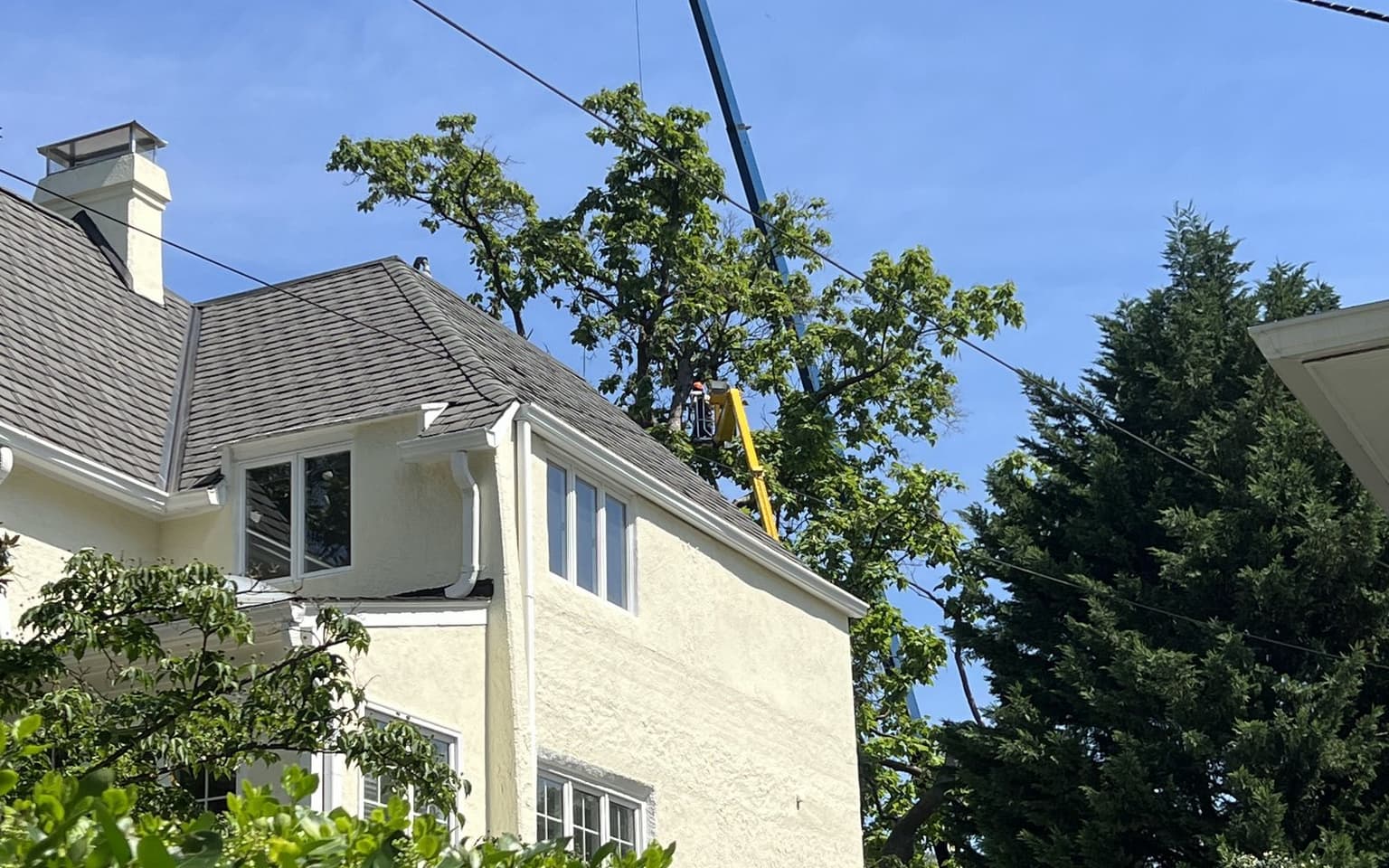
The garage took no further damage during the removal. Once the catalpa was on the ground, significant decay was visible inside it — the kind that is invisible from the outside of a standing tree in full leaf, and a reminder of why a trunk that looks solid can still fail in a storm.
The questions homeowners do not always ask
These come up on nearly every difficult-access job, and they are reasonable questions. Here is how they were answered on this one.
- “Will the fence have to come down?” On this job the root plate had already broken the fence when it lifted. Where a fence is sound, taking a panel out and putting it back is usually cheaper and faster than working around it — but it is a conversation to have before the day, not during it.
- “Will the equipment fit?” That is the question that decides the whole plan. Here it took a crane truck sized for a narrow alley plus a tracked lift brought in from the neighboring property, because nothing standard could reach the tree from the customer’s own side.
- “What protects the lawn?” Plywood matting under the outriggers and along the travel path. It spreads the load so the machine does not sink in and does not leave ruts.
- “What happens if the ground is wet?” Saturated ground is the usual reason a job moves. Tracked machines and matting help, but there is a point past which putting weight on soft ground damages the yard more than waiting a day does.
- “What is included in cleanup?” On this job, all wood off site. What gets hauled and what gets left — chips, rounds for firewood, the stump — is part of the written estimate rather than something to settle at the end.
Why the equipment mattered here
A crane on its own would not have done this. What made the removal possible was the combination: a crane truck that fitted the approach, a spider lift positioned from a neighboring property, matting to protect the ground, coordinated road closures, and a crew sized to keep small lifts moving steadily out of a confined area.
Owning several cranes and specialist access machines is what lets us commit to a storm-damaged tree quickly when it cannot safely be reached with ordinary equipment — which is usually exactly when it needs to come down.
See more photographs and short video from this removal in the album from the job.
If a storm has left a tree on your house
If a storm has left a tree split, uprooted or leaning on a structure in Chevy Chase, Bethesda, Kensington or anywhere else in Montgomery County, send us photographs of the tree and what it is resting on. We will tell you what it will take to get it down safely and quote the work. If it is actively unsafe, call instead of emailing — that is emergency work and we answer around the clock.
If the tree is still standing and you are not sure whether it should be, that is a different conversation — an inspection and risk assessment, before the next storm rather than after it.
Frequently asked questions
- Why use a crane and a spider lift on the same tree?
- They do different jobs. The crane takes the weight and carries each cut section out of the site. The lift puts the climber in position to make the cut where climbing the tree itself would be unsafe — which it was here, because the trunk had split and the root plate had lifted, so the tree could not be trusted to hold anyone.
- Can a tree be removed if there is no access to the back yard?
- Usually, but the method changes and so does the cost. On this job the answer was a crane truck narrow enough for a driveway alley plus a tracked lift brought in across a neighboring property. Tracked machines travel over lawn on matting and need far less room than a conventional boom truck.
- What stops the equipment wrecking the lawn?
- Plywood matting under the machine and along its travel path, which spreads the weight so it does not sink in or leave ruts. Tracked machines also spread load better than wheels. Saturated ground is still the limit — past a point it is better to wait a day than to churn the yard.
- My neighbor and I share the tree. Who arranges the work?
- Whoever wants it done usually starts the conversation, but a tree on a property line affects both owners and access is often needed from both sides. Sorting that out before the crew arrives is what keeps the job on schedule. We can talk to both households.
- The tree is leaning on my garage. Is it holding the garage up, or the other way round?
- Often the structure is holding the tree. That was the case here, and it changes the sequence of the work completely — the weight above has to come off in controlled pieces before anything shifts, rather than the tree being pulled away from the building.
- How quickly can you get to a storm-damaged tree?
- Emergency response is around the clock. How fast a tree can actually be removed depends on access, on whether roads or utilities are involved, and on how many properties the work touches. A tree resting on a structure is assessed straight away.
- Was there anything wrong with the tree before the storm?
- Once this catalpa was on the ground there was significant decay visible inside the trunk. That is common and it is the argument for having large trees near structures looked at before storm season, because interior decay is not visible from the outside of a standing tree in full leaf.
- What happens to the wood?
- On this job all of it was hauled off site. What leaves and what stays — chips, rounds cut for firewood, the stump — is agreed in the written estimate beforehand.