September 11, 2026
What to Do When Your Insurance Company Requires Tree Trimming or Threatens Non-Renewal
Your insurer wants branches cut back or a tree removed. What the letter means, when pruning is enough, when an arborist report helps, and how to document it.
By John Ritz Miller, Jr. — ISA Certified Arborist MA-7241A, Rock Creek Tree, Turf & Landscape LLC
Published September 11, 2026
If your insurance company has sent you a letter about trees or branches over your home, start with two things: exactly what work is being asked for, and the date it has to be finished by. Then, before you authorize aggressive pruning or a removal, have the trees assessed by a Maryland Licensed Tree Expert or an ISA Certified Arborist who can work out how to resolve the insurer's concern without needlessly ruining a tree that is otherwise sound.
We take these calls regularly across Rockville, Bethesda and Silver Spring, and the pattern is nearly always the same. The letter is short, the deadline is real, and the homeowner has no idea whether the insurer wants a few limbs shortened or the whole tree on the ground. The gap between those two answers is usually several thousand dollars and a mature shade tree.
Here is how to work through it.
1. Read the letter for five specific things
Most of what you need in order to plan the work is in the letter, but it is rarely laid out clearly. Go through it and write down:
- Which trees — by location if the letter names one, or “unspecified” if it does not.
- Which structure is at issue: the roof, a detached garage, the service drop, a fence.
- The clearance or condition required. Some insurers ask for a specific distance from the roof; others simply say “overhanging limbs.”
- The deadline. Thirty, forty-five and sixty days are all common. Note whether it is a completion date or a response date — they are not the same, and the second is often more generous than people assume.
- What proof they want back — photographs, a paid invoice, a contractor's letter, or an arborist's assessment.
If the letter is vague on any of these, that is not your problem to solve by guessing. It is a question to put back to the insurer.
2. Ask the insurer to identify the exact tree and the exact concern
You are entitled to know what specifically triggered the letter. Call the agent or the number on the notice and ask for the tree's location, the date of the inspection, and any photographs the decision was based on.
This matters more than it sounds. A great many of these letters originate with a third-party inspection vendor rather than an underwriter who has seen the property, and the description that reaches you can be generic enough to fit any house on the street. On more than one Kensington and Chevy Chase job we have arrived to find that the tree in the photograph belonged to a neighbor.
3. Do not start cutting before the tree has been assessed
The instinct when a deadline is attached is to have someone take everything back hard and be done with it. Resist it. Topping a tree, stripping out its interior branches, or removing a large share of the live canopy in one pass does real damage: it forces weak, fast regrowth that is more likely to fail in a storm, opens large wounds the tree cannot close, and accelerates decay in the trunk and scaffold limbs.
The outcome is worth being blunt about. An insurer asking you to reduce risk can end up with more of it three years later, on a tree that now needs removing — at your expense, and with the same letter arriving again.
Good pruning does not look dramatic. That is the point.
4. Use someone legally qualified to do the work in Maryland
Maryland is one of the few states that regulates this directly. Under the state's Tree Expert Law, tree care performed for compensation on private or public property must be done under a Maryland Licensed Tree Expert, licensed through the Department of Natural Resources. The law dates to 1945, licenses renew every two years, and licensees must carry and show proof of liability and property damage insurance.
Two credentials get used interchangeably, and they should not be:
- Maryland Licensed Tree Expert (LTE) — a state license. It is what makes the work lawful here.
- ISA Certified Arborist — a national professional certification from the International Society of Arboriculture, earned by examination and maintained with continuing education. It is what qualifies someone to judge a tree's condition and write about it credibly.
For an insurance letter you generally want both in the room: the license to do the work, and the certification behind the assessment your insurer is going to read.
5. Work out whether pruning can satisfy the request
In most cases it can. The question is which kind, and the distinction is worth understanding before you approve an estimate.
Selective clearance pruning
Removing or shortening the specific limbs that overhang or contact the roof, chimney or service line, cutting back to a suitable lateral branch. This resolves the majority of insurance letters and, done properly, takes very little from the tree overall. It is ordinary tree pruning, carried out with a particular target in mind.
Structural pruning
Correcting defects in how the tree is built — competing leaders, included bark in a union, branches attached too weakly to hold their own weight. This is the right answer when the concern is not roof clearance itself but the likelihood of a limb failing onto the house.
Reduction pruning
Reducing the height or spread of the whole crown by cutting back to live laterals large enough to take over as the new leaders. Appropriate for a tree that is genuinely too large for its position. It is not the same as topping, which is indiscriminate and damaging.
Removal
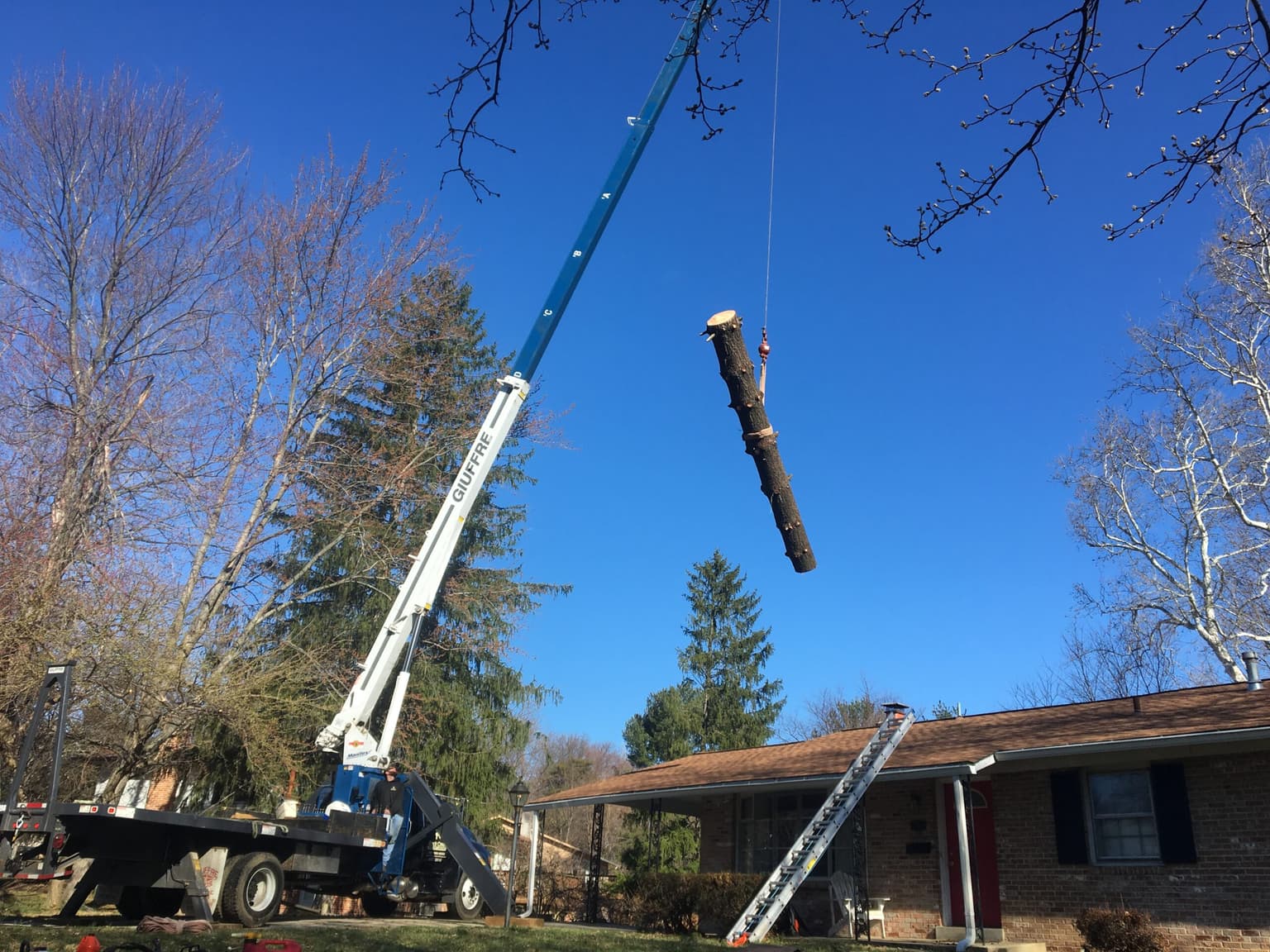
The right answer when the tree is dead, structurally unsound, or so close to the structure that no amount of pruning creates the clearance without destroying it. On the tighter Potomac and Chevy Chase lots this sometimes means crane-assisted removal, because there is nowhere to drop anything.
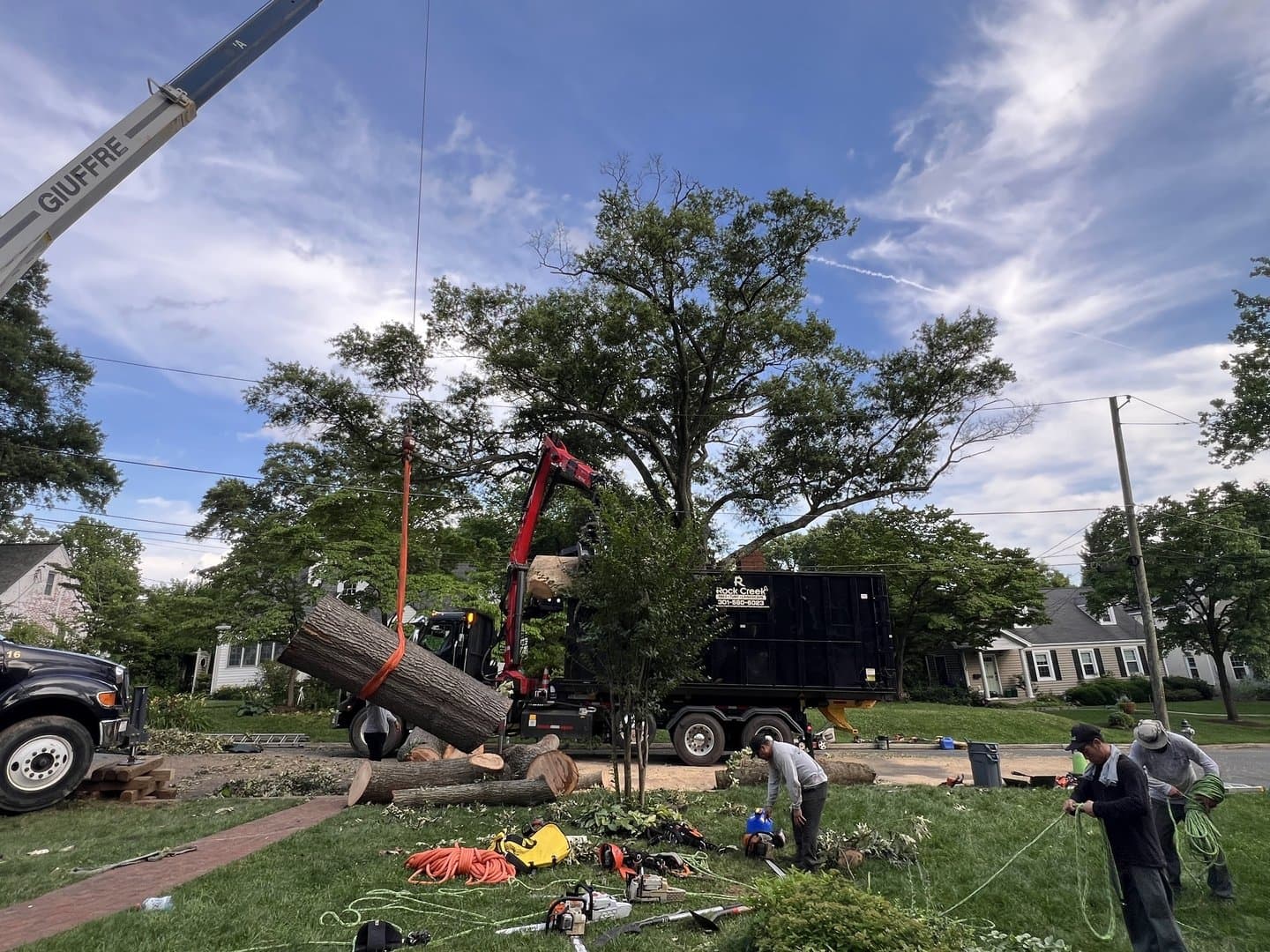
Proper pruning follows the ANSI A300 standard, which is the industry's technical answer to where a cut is made and how much can come off at once. A reputable estimate will tell you what is being removed and why.
6. Document the work as you go
Whatever the insurer asked for, assume you will need to prove it happened. Keep:
- The written scope of work, describing what was pruned or removed.
- The paid invoice, on the company's letterhead, showing the license.
- Before-and-after photographs taken from the same position — ideally the angle the insurer's own photograph was taken from. A pair shot from one spot is far more persuasive than a dozen taken at random.
- Any written assessment or recommendation your arborist provided.
We provide the scope, the invoice and the photographs as a matter of course on this kind of job, because we know where they are going.
7. Send it in, and get written confirmation back
Submit the package the way the letter tells you to, then follow up until someone confirms in writing that the requirement is satisfied and the policy is not being cancelled or non-renewed. A phone call in which someone says it looks fine is not a record.
One thing we say plainly to every customer in this situation: no tree company can guarantee what an insurer decides. Underwriting and renewal are the insurer's call. What a qualified contractor can do is resolve the actual hazard correctly and hand you documentation that clearly shows it.
8. When an arborist report is worth getting
A written arborist report is a separate piece of work from an estimate — an assessment of the tree's condition, the risk it does or does not present, and the recommended treatment. It is worth commissioning in four situations:
- The tree looks healthy to you, and you want a professional judgment on the record before agreeing to remove it.
- The insurer's demand is unclear, or appears to ask for more than the condition warrants.
- The requested pruning would harm the tree. A report can set out what can be done safely, and what cannot, in terms an underwriter can act on.
- You need documentation of the tree's condition — for the insurer, a future buyer, or a neighbor dispute.
Some insurers ask for one directly, particularly when the clearance they want cannot be achieved without severely damaging the tree.
9. If the letter is based on an aerial or satellite photograph
This has become common, and Maryland has taken a position on it. In Bulletin 25-10, issued on 17 June 2025, the Maryland Insurance Administration advised insurers that satellite or aerial imagery may be used as the basis for a cancellation, non-renewal or claim denial only where the image gives a clear, accurate and current view of the property.
The bulletin states that images which are low-resolution, out of focus, blurry or dated do not accurately represent a property, and cannot on their own justify a cancellation or non-renewal based on the property's condition without further investigation. Where imagery suggests a possible problem without establishing that it exists, the Administration's guidance is that the insurer should investigate further to confirm it.
In practice, that means it is reasonable to ask your insurer for the image, the date it was captured, and confirmation that it reflects the property's current condition — particularly if work has already been done since. We have seen letters in Gaithersburg and Rockville citing trees that had been pruned the previous season.
This is general information, not legal advice. Questions about your specific policy belong with your insurer, your agent, or the Maryland Insurance Administration.
Send us the letter
Did you receive a tree-related letter from your insurance company? Send Rock Creek a copy of the letter and photographs of the trees involved. Our arborists can evaluate the concern, recommend appropriate pruning or removal, prepare a written estimate, and discuss whether additional arborist documentation may be appropriate. If a tree has already failed or is actively unsafe, call us instead — that is emergency work, not a scheduling question.
Frequently asked questions
- Can my insurance company require me to trim or remove a tree?
- An insurer cannot make you cut anything on your own property. What it can do is set conditions for continuing to insure the property, and decline to renew the policy if they are not met. In practice that gives the request real weight, which is why the deadline in the letter matters.
- Do branches over a roof automatically mean a tree is unsafe?
- No. A great many healthy, well-structured trees have limbs over a roof and always will. What matters is the species, the tree's condition, how the limbs are attached, and what would happen if one failed. That is a professional judgment rather than a measurement, and it is what an arborist assessment is for.
- Should I remove the whole tree or only prune the overhanging branches?
- Prune first, unless the tree is dead, structurally unsound, or so close to the structure that the clearance is impossible without destroying it. Removal is the more expensive answer and usually the less appropriate one.
- What if the requested pruning would severely damage the tree?
- Say so in writing, with an arborist's assessment behind it. Insurers will sometimes accept a documented alternative — reduction rather than removal, or a staged plan — when a qualified professional explains why the original request is counterproductive. Sometimes they will not, and then it is your decision to make.
- When is an arborist report needed for an insurance company?
- When the tree appears healthy and you want a professional judgment on the record, when the insurer's demand is unclear, when the requested work would harm the tree, or when you need the tree's condition formally documented for the insurer, a buyer or a neighbor.
- What should I send the insurance company after the work is completed?
- The written scope of work, the paid invoice showing the contractor's license, before-and-after photographs taken from the same vantage point, and any arborist documentation. Then request written confirmation that the requirement is satisfied.
- Can an arborist guarantee that my policy will be renewed?
- No, and be wary of anyone who says otherwise. Renewal is an underwriting decision that belongs to the insurer. A qualified arborist resolves the hazard correctly and documents it thoroughly, which is the part you control.
- What should I do if the insurer is relying on an aerial photograph?
- Ask for the image itself, the date it was captured, and confirmation that it reflects the property's current condition. Maryland Insurance Administration Bulletin 25-10, issued in June 2025, addresses the use of satellite and aerial imagery in cancellation and non-renewal decisions and states that such images must be clear, accurate and current.
- Who is legally qualified to perform paid tree work in Maryland?
- Tree care performed for compensation in Maryland must be done under a Maryland Licensed Tree Expert, licensed by the Department of Natural Resources. Ask for the license number before work starts — on any job, not only an insurance one.
- How quickly can Rock Creek evaluate an insurance-related tree concern?
- Call with the letter in hand and tell us the deadline it carries, so we can factor that into scheduling. On-site evaluations are free, and if a tree has already failed or is actively unsafe we respond to emergencies around the clock.